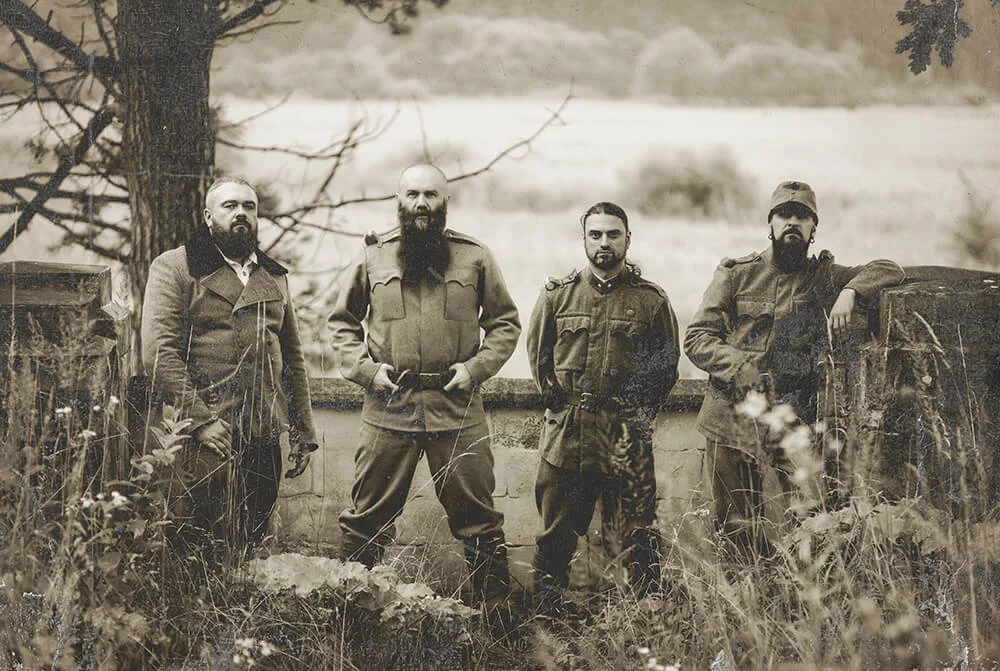
Scorpio: Hey Dmytro! What should I call you — Dmytro or Ditmar, your stage name?
Dmytro: Let's go with Dmytro — keeps it human.
S: Thanks for making time for this. For anyone who doesn't know you yet: who are you, where are you from, and where are you right now?
D: Dmytro Kumar, vocalist of 1914. I'm in Ukraine, in Lviv. Same place I've always been.
S: How are things with the band right now? You put out a new album in November — is promo still going strong?
D: Promo is in full swing. Reviews keep rolling in, nominations, "album of the year," "album of the month," charts here and there. We landed in some charts in Germany, which was honestly a bit of a shocker to me — seriously, a band from Lviv charting? But right now the biggest thing is tour prep. Fingers crossed, a tour in support of the new album is supposed to happen at the end of March. I really want to do it, because — as ridiculous as it sounds — as a band we haven't done a proper tour in five years. We'd go out situationally — ten-day runs, last minute shows. People would set up gigs along the route just so we could talk about the war, about Ukraine, collect donations for our guys. It somehow worked out like that, because we either couldn't get exit permits or something else kept coming up. Constant complications. So right now tour prep is going full speed. It's a big deal, but because of it I'm honestly losing track of what's happening with the album. There's so much logistics: getting documents sorted for the whole band, applying here and there — a mountain of tedious paperwork.
S: What's the tour geography?
D: I don't remember. (laughs) First show in Poland, in Warsaw. What comes after that — I'd have to check, there's a post somewhere on Facebook. I know Germany, Belgium, Netherlands, France are definitely in. Scandinavia is in — we're playing Inferno Festival in Norway. Finland's there. Oh wait — logically, if Finland's there and we're coming from Poland, then Lithuania, Latvia, Estonia must be somewhere along the way. Let's not speculate. (laughs)
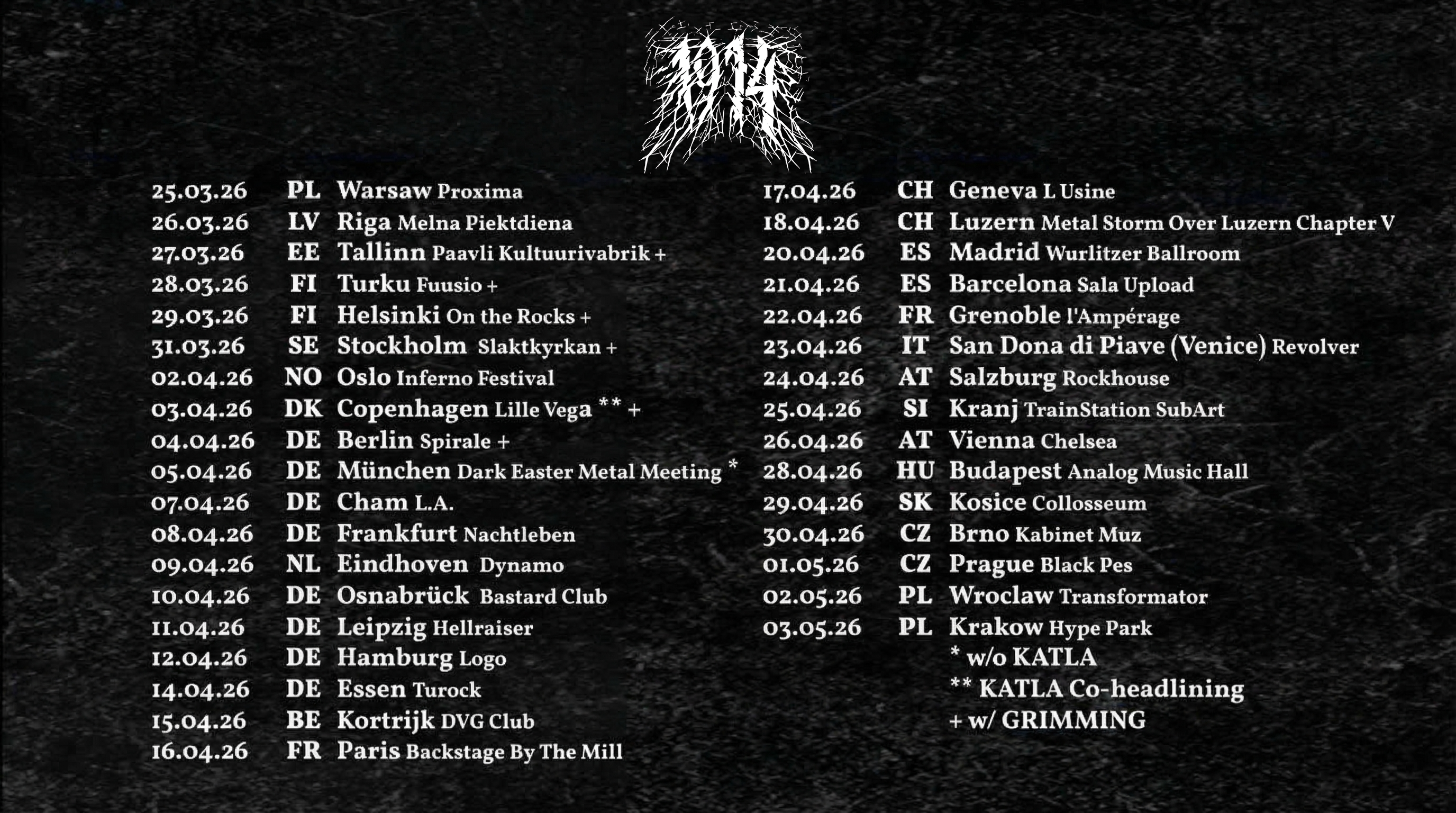 1914 European Tour, March 25 – May 3, 2026
S: We'll make sure to add all that to the piece. I also saw in the plans — and there was an announcement — about a show later this year in the States at Maryland Deathfest. Is this potentially the first US show? And what are the odds it actually happens?
D: Can I use profanity in this interview?
S: Go for it.
D: We finally, fucking, applied for an American visa. It is the most idiotic procedure I have ever seen, ever. We literally wasted an entire month — gathered the whole band, applied for the visa type the American organizers specified. We look in Ukraine — that visa type isn't available in Kyiv. So, Krakow. Fine, Krakow. We apply in Krakow, they won't process us for two weeks. Then it turns out Ukrainians can't apply for that visa type in Krakow at all, and this is written nowhere on the website. Our Polish friends had to call the consulate directly to find out. Fuck, alright. Where then? Warsaw. We apply in Warsaw, and at the payment stage there's constantly something wrong — the transaction won't go through. Again our Polish friends call the Warsaw consulate, and they say: "Oh, we only accept payment with Polish cards, only in zloty." Obviously a Ukrainian card won't work. Kurwa, ja pierdolę. We sit a Polish friend down with us online, and he pays for the whole band's five visas — two hundred and five dollars each, over a thousand dollars total — with his Polish card. Maryland Deathfest has already pissed me off and it hasn't even started. (laughs) And we haven't even bought flights yet. But on the prep side we've done everything possible: we already have a booked consulate interview in Poland. So the chances of flying out to the States are real and decent — even if the US consulate website does everything to make sure you don't.
S: Let's talk about the positive experience then — Mexico. That was the first show on the American continent for the band, right?
D: Yeah. We had US tours planned back in 2022 — big European tour, then US tour back to back. Obviously everything got cancelled, because of the fucking russians. Then Ukrainian bureaucrats who are, in some ways, even worse than the fucking russians. And only now did we manage to fly out to Mexico. Great experience, but a one-off festival — that's hardcore. (sighs) You're standing at the border, the Poles search you, our side searches you. Why? Where? Why? Five or six hours at the border, then you drive to Krakow, fly nineteen hours through Turkey to Mexico. Jet lag and all that. You land completely cross-eyed, no time to get your bearings. And you've got a tight schedule — the ministry permit is for one festival, a couple of days — and that's it. (laughs) You play a six-hour set. A bit of time to sleep, wash up, get yourself together. Some musicians sleep, some hang out, talk about Ukraine. Then you get on a plane and fly twenty-one hours back. Border again — you photograph your passports and send them to the ministry: "Hey, we're back." And privately you're like: "What the fuck was that?" Great experience, but intense. It'd be nice to stretch those trips out a bit — but not now. The main thing: we came out with the Ukrainian flag. People in the crowd had Ukrainian flags. The organizers hung a flag on the stage. A lot of people came up: "We in Mexico honestly have no idea what's going on over there. Tell us something." And that's cool — people didn't just come to drink beer, there was actually a queue to listen. We told all the musicians there what was going on, who the bastard is (laughs) and all that. The communicative mission — fly in, make a statement, talk about Ukraine, talk about our war. I think we more or less accomplished that. And in the States we'll keep it up — there we'll have to chew it up and spell it out even more carefully: who the bastard is, who the ginger bastard is and why. (laughs)
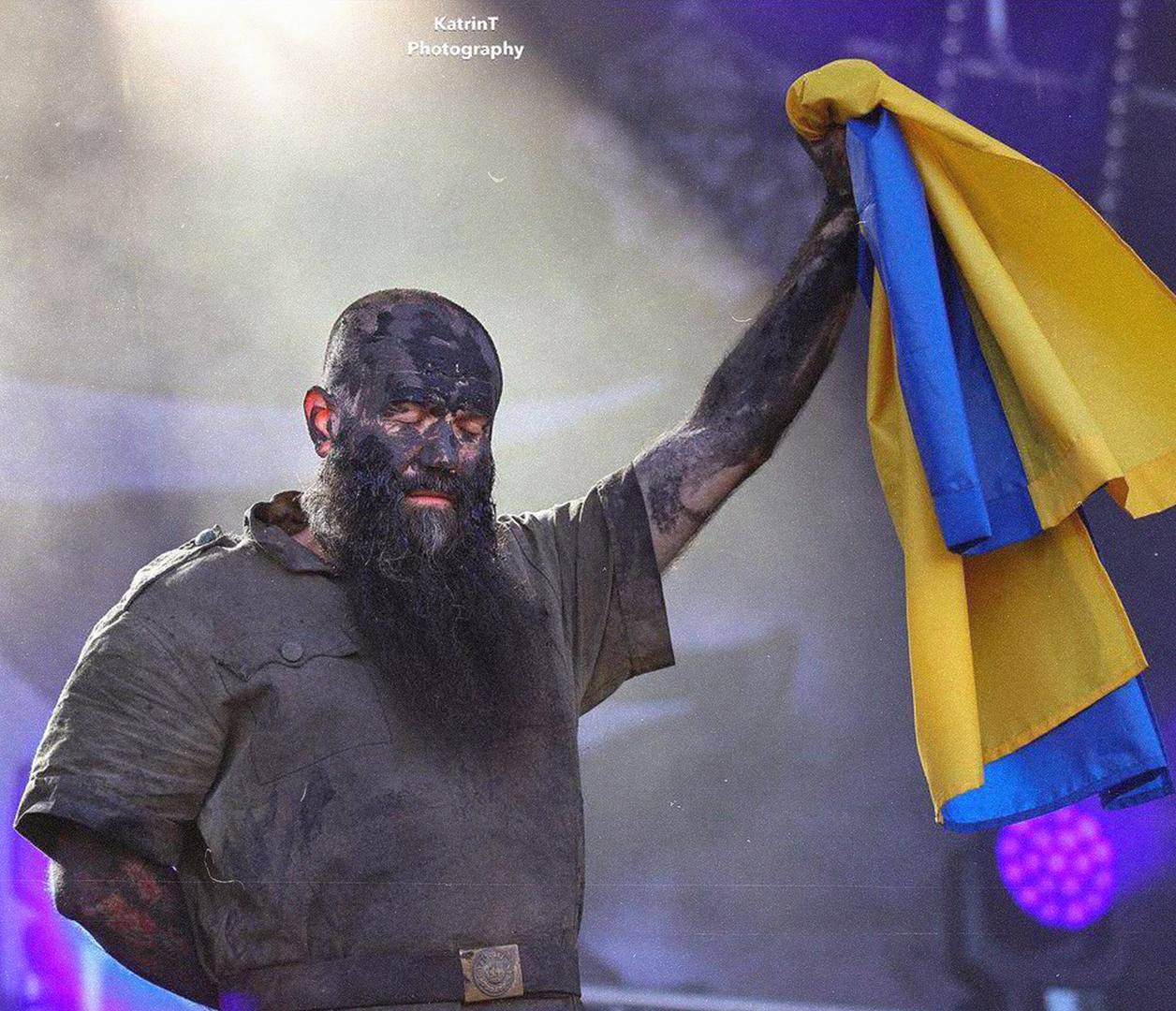 Photo: KatrinT Photography
S: Let's talk about the latest album. It came out the day before my birthday, so I partly took it as my own personal gift. (laughs) It's named after Franz Joseph's motto. I'm from Chernivtsi, from Bukovyna — and the name of your album literally hangs on the city hall there, along with the translation: "With United Forces." Coincidence, or is there a connection?
D: Franz Joseph officially gifted that motto to Chernivtsi, actually. The city received official permission to display it on the central city hall — it wasn't just some city council decision, it was an imperial grant.
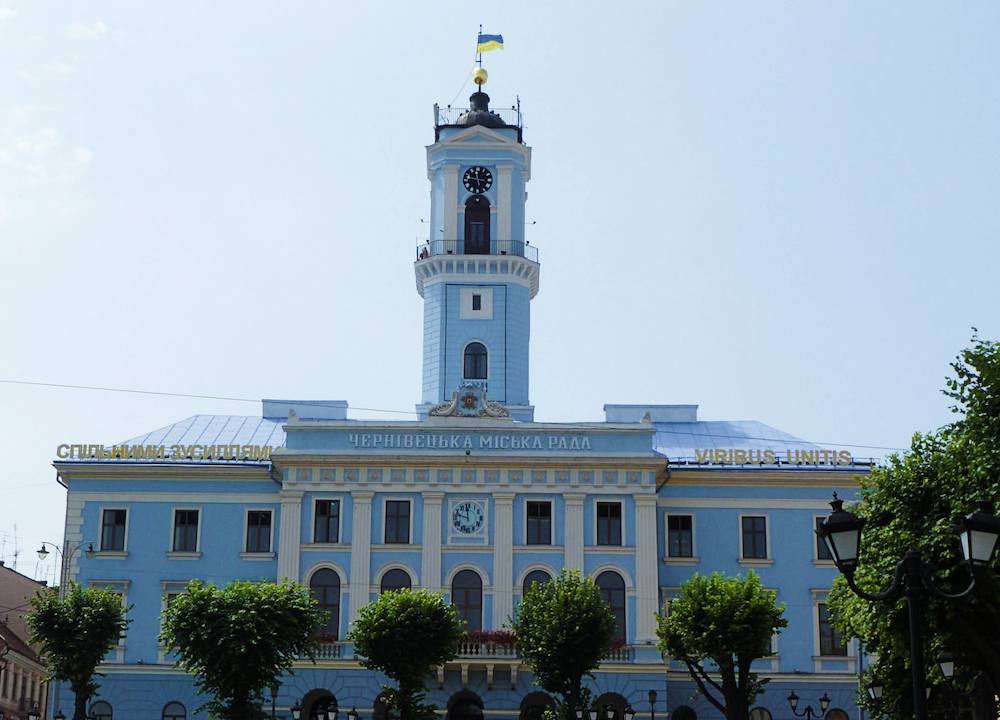 Chernivtsi City Hall — "Viribus Unitis" and "Спільними зусиллями" inscribed on the facade
S: I thought it was some modern decision.
D: Nope. For me this title is a bridge between WWI and the present. Back then there was the great Austro-Hungarian Empire, with many nations who sort of hated the Austrians, the Hungarians, and each other — and yet they all did something together. Something great. The empire is a great machine, everyone pushes somewhere, everyone does something. They were making things happen through united forces. Yes, it was under compulsion, under the empire's whip. Nobody cared about the individual. But come on — who cares about the individual now? Nobody ever did. But everyone was united by a common goal — for example, beating the shit out of the russians. Good goal? Great goal! And everyone in the Austro-Hungarian Empire was united by it. I always explain this to Europeans: for me this is a statement — we need to come together again. Not into the Austro-Hungarian Empire — who needs the Hungarians — but into some shared European space. With united forces, turn our gaze East again and understand that the threat to your entire civilization, your values, your lazy comfortable settled life — everything you know and love — is coming from there. It's a monumental threat. And somehow you're still not clicking onto this. I don't understand why. Whether you're hiding or just not seeing it. So Viribus Unitis is a call: let's unite and with united forces beat the shit out of the russians. (laughs) The book has descriptions of Slovenians too, and Poles, and Hungarians — who heroically defended Przemysl, you understand? A Ukrainian-Polish Przemysl heroically defended by Hungarians against the russians — what the hell? Globalization and imperialism are terrible things, but in the context of this title, of united forces, it makes sense.
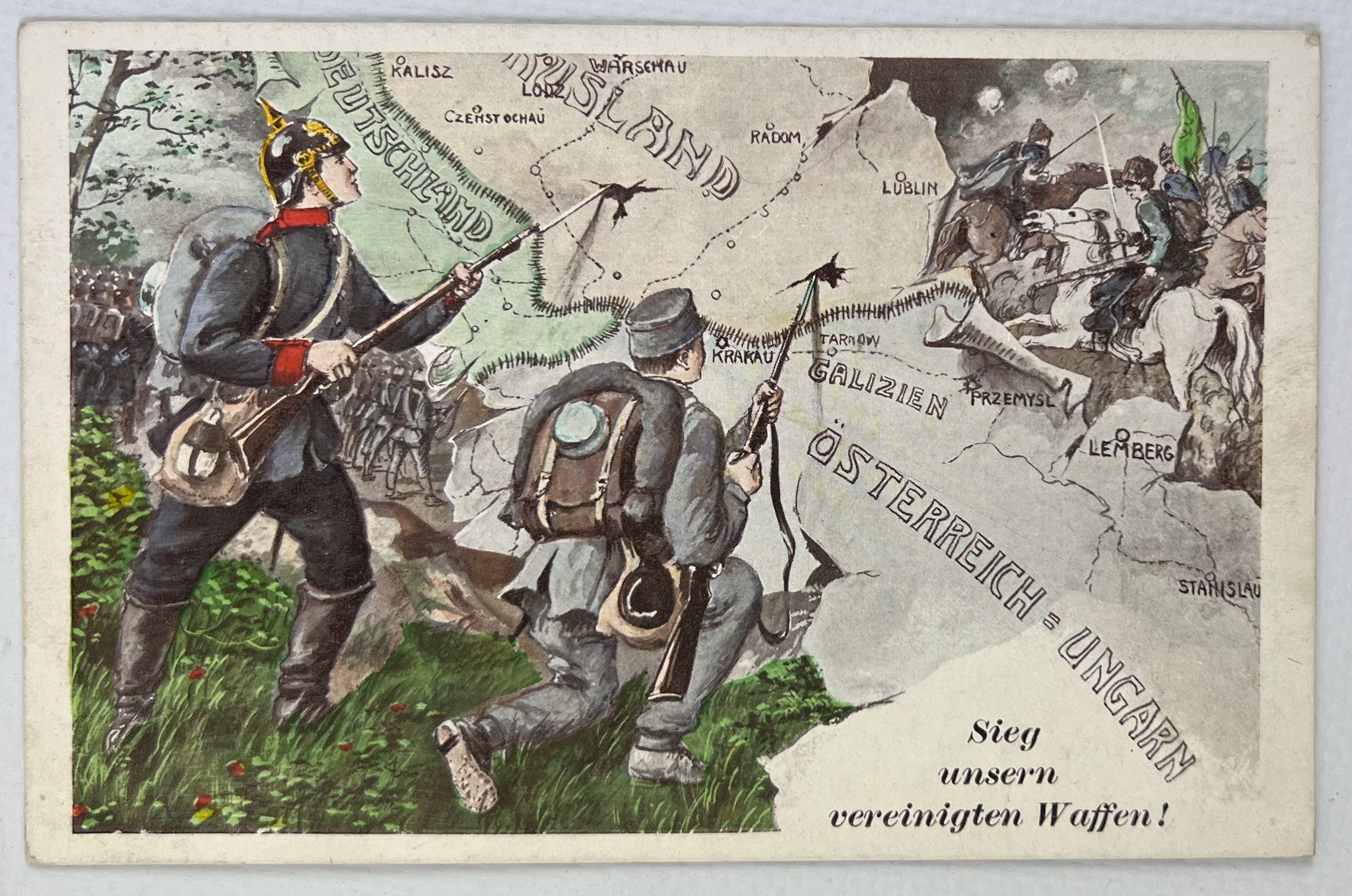 "Sieg unsern vereinigten Waffen!" — Victory to our united arms. WWI postcard, Eastern Front
S: I was in Vienna about ten years ago, at the Military History Museum. They have these wonderful phrasebooks — common phrases in several languages including Czech, Ukrainian, Polish. We had a great laugh at them. Generally the Vienna museum is one of the few places where you walk in and still feel this imperial grandeur.
D: Exactly — you walk in and understand: the empire never really went away. The Austrians present it all with such pride, the scale, the grandeur. Because the Germans regarding WWI and WWII are like: "Mmm, we're ashamed, we sort of..." The French present themselves as a nation that suffered greatly — and rightly so, nearly two million men were wiped out, you can't argue with that. But the Austrian presentation — magnificent. I love going to that museum just to walk in and soak it up: "Mmm, Grandma Austria. Good stuff." (laughs) The little Galician inside me ticks a little box: "Good."
S: The latest album tells the story of a real soldier — a Ukrainian from Lviv serving in the Austrian army. How did you find this story? Are there surviving relatives of Ivan? How did the archival research go?
D: About the relatives — I don't want to reveal that yet. I want to keep some distance for now. But I'll say this: Ivan's family exists, and they know about the album. It will eventually come out on our social media. The research happened thanks to historian colleagues — I had help from scholars in Vienna, Rome, Prague, and Lviv. Two university professors from Lviv. They really helped, gave a lot of information. The Austrians and Italians gave me online access to archives. Most of those archives are long digitized — you sit and sift through them for hours, days, weeks. Next document, next document, next — and your brain just swells. Tens of thousands of letters, memoirs, diaries, maps. To process all of it you'd need several lifetimes. People often ask me: "Are you planning an album about WWII?" — come on, there's so much left to say about WWI, I'd need three more lifetimes just to cover the most interesting events. Not close it off as an anthropological phenomenon — just the interesting moments. There's an enormous amount of material. I'm a layman, of course — not a professional historian, not a cartographer, not trained to work in archives. It takes me longer than it would a specialist. But it's no less fascinating. I have a ton of literature on my computer that simply doesn't exist online. Historians would tip me off: "Download this one, just don't publish it anywhere and don't take screenshots." (laughs) Most of the Vienna material is in German — some in archaic German script. By the time you translate it, by the time you understand the context. (laughs) In total it took over half a year of painstaking work pulling this story together. I communicated with a lot of historians on forums, with collectors. The book has several photographs — including a full spread of the entire LIR №19, the infantry regiment where Ivan started his service. That photograph is being printed for the first time — it doesn't exist online. A collector who owns the physical copy photographed it and sent it to me, asking only that I not post it on forums. For the book — yes. I have several items like that — I would call people, explain the purpose, what I was working on. Unique, interesting photos. Not all of them fit — there's so much material, we had to cut both text and images. But I already know which direction I'm heading next. I'll probably start preparing the next album two years before release, sitting in some archive somewhere. (laughs)
S: By the way — following the pattern of the song about Private A. G. Harrison from the previous album. That's a real letter, right?
D: Yes. A death notice sent to a soldier's mother. A real letter, found in the British archive. When we released that track, about two or three months later his great-granddaughter wrote to me directly. An older woman, a classic British grandmother — we still talk. She supports Ukraine, after every major strike that shows up in their news she always writes: "How are you?" It's so warm and incredible. She sent old photographs — her grandmother with him, her mother. She photographed an old vintage British lunchbox — the one he had before the war. These are such fascinating crossovers. With Ivan, I suspect something similar will happen in time. And speaking of A. G. Harrison — people still make the pilgrimage. Two days ago I got a message on Instagram: "We're getting hyped for your tour, and to get ourselves in the spirit we went to Belgium — visited the memorial, found A. G. Harrison." They're taking photos — there's Private — and that's real dedication. After things like that you sit and think: "Maybe I did something right in life, something that mattered." It gives you the drive to keep going.
S: Absolutely. I was in Quebec last year — probably the most European city in all of North America. There's still a fort, a citadel, a museum, and the Vimy Ridge memorial. I learned about Vimy Ridge from your previous album, actually.
D: (laughs) That's strange. Though — maybe not, if someone doesn't follow military history. I was desperate to get to Vimy Ridge — I visited back in 2017, and it was important to me. To come, see it with my own eyes, walk the ground, absorb that energy. Many people tell me they heard about Filip Konowal for the first time through our track. So there's some minimal educational work happening. Because, as I always say: we don't play music. Music for us is secondary — a vestige. All of this could be wrapped in different art forms, we chose music. We tell stories. My mission is to convey the pain, the absurdity, the spirit of WWI. My own emotions — not from WWI itself, but from digging up and burying dead soldiers of that war. Purely anthropological-historical observations that I share. If it weren't music it would probably be books, or I'd try my hand at filmmaking. But it's music.
S: Your albums feature some notable guest vocalists: Aaron from MY DYING BRIDE on the latest, Nick Holmes before that, Sasha Boole — and another Chernivtsi connection — on the previous one. How do these collaborations come about?
D: You forgot David Ingram from BENEDICTION on The Blind Leading the Blind. Also iconic.
S: And Jerome Reuter from ROME on this one.
D: All iconic to me personally. How does it happen? It's simple: I just love their music. (laughs) There's none of this "let's do a feature with those guys for the hype." If we were chasing hype we would have done a feature with SABATON (laughs) or AMON AMARTH. But I only focus on people whose music personally moves me. Take Christopher Scott from PRECIOUS DEATH — most of my friends have never even heard of that band. But I've loved them since the nineties. I have CDs I bought in 1999. I'm scrolling Facebook and suddenly I see that PRECIOUS DEATH have reunited after nearly thirty years and are recording. I went, pulled out the CDs, re-listened. Holy shit, great — groove, thrash, funk, that crossover sound of the nineties. I thought: why not? I wrote: "Hey, I've loved your music since the nineties, how do you feel about a collaboration?" The guy: "Holy shit! Let's do it!" No "does this fit the vibe." I just love it — that's it. Obviously it gets discussed with the band — I come in with an offer they can't refuse. (laughs) I can be persuasive.
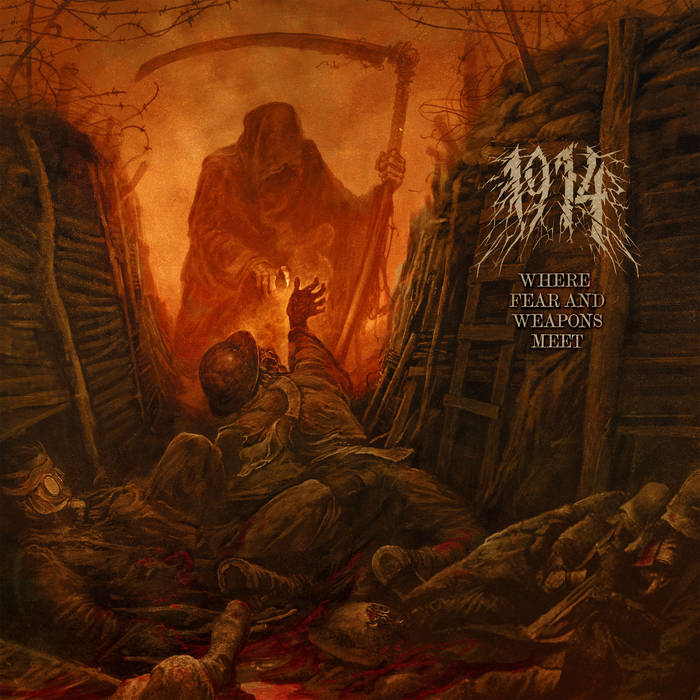 1914 — Where Fear and Weapons Meet (2021)
S: On your releases you often use fragments of authentic period recordings. Like the intro on the latest album — I actually thought at first it was the German anthem, "Deutschland über alles." Then I dug into it and found it's Haydn, originally written for the Austrian Empire.
D: Right, end of the eighteenth century. And you won't believe this — every single time I did an interview with some German zine, the interviewer would ask with a dead-serious face: "Please tell us why you decided to include the German national anthem?" And you're sitting there: "Zina, what the fuck, seriously? Just Google it, listen to the lyrics — they're singing in your language."
S: And where do you find these old recordings?
D: There are many specialized archives. Including the magnificent Library of Congress in the US — paid access. I paid for it. At one point I paid over three hundred bucks for it — there are different tiers: you can listen, you can download. The Austrian archive has also digitized a huge amount of material — entire records. The Library of Congress has, for example, all of Woodrow Wilson's speeches from 1917 — three hundred of them. You sit down and go through them: does this fit the context? Three days listening to Woodrow Wilson — and: "Fuck, nothing fits." Next. That's the format — and that's how you find what you need.
S: We already mentioned the deluxe edition of the latest album with the book. How did that idea come about, who did the layout, who helped you put it together?
D: The idea came about completely naturally, because I wanted to write a book. (laughs) Old joke: "Chukcha not a reader, Chukcha a writer" — that's exactly the Chukcha who always wanted to write a book. I realized that the amount of background behind the album couldn't be conveyed in any booklet. I started writing bullet points — things to mention in the booklet. When I had twelve pages of A4 just in those notes, I realized: I've gone off in the wrong direction. I called the manager at Napalm and asked: "If I do this in book format, can we publish a book?" They looked at me blinking: "Are you out of your mind? What do we need a book for? Are we a bookshop?" (laughs) "We're a music label, but let's think about it." I said: "Let's make a book, put a CD with it — and everyone will read the book." They: "Who's everyone?" (laughs) They brought me back to reality a bit — because I often float away with my ideas into other dimensions. There's a market, there's money, there's consumer behavior. (laughs) But somewhere in the middle we found common ground. They told me the maximum: seventy-two pages. I open my file — and there are already two hundred and eighty A4 pages. (laughs)
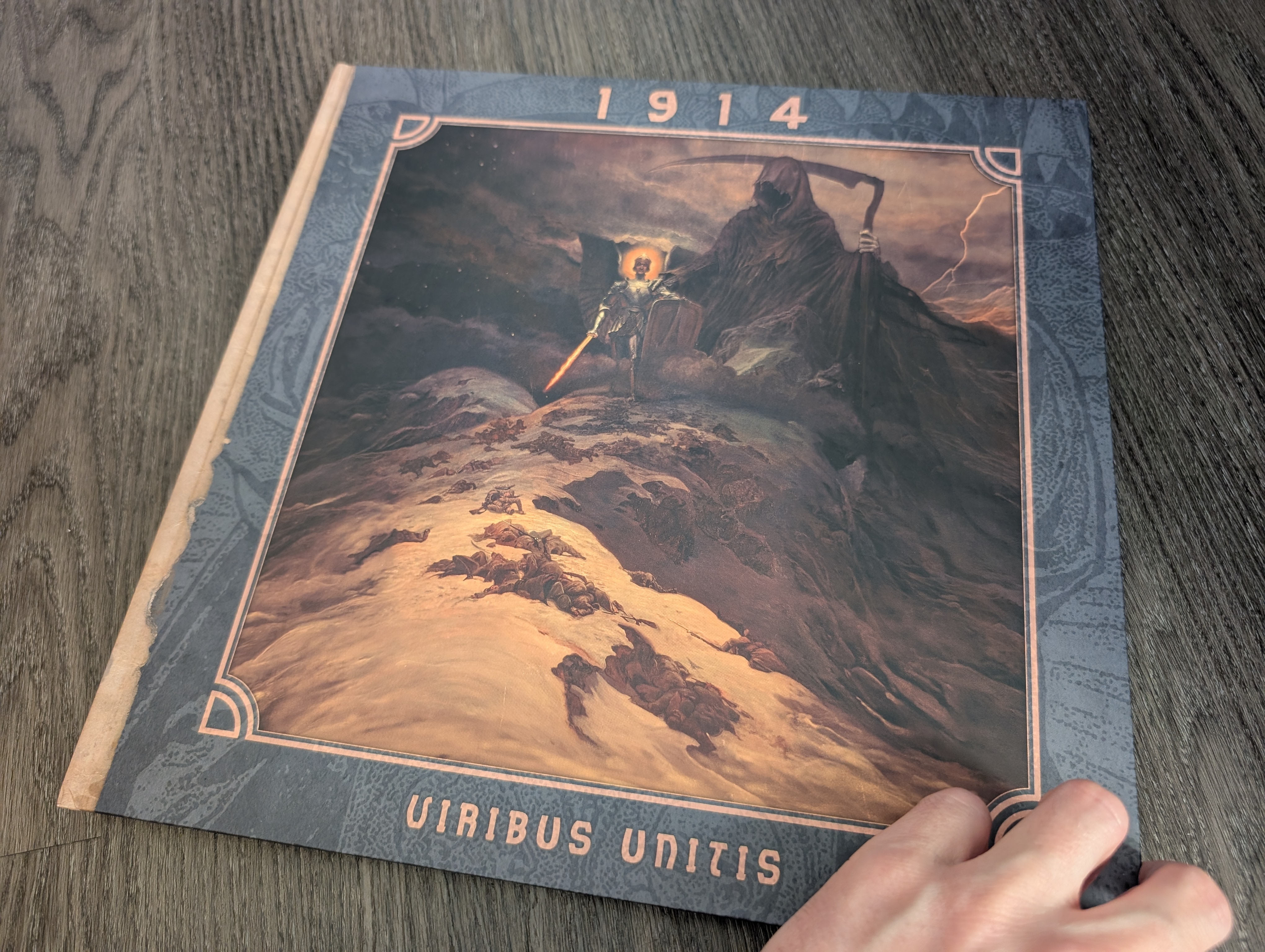 Viribus Unitis deluxe book edition
So I start cutting: cut here, cut there. The designer and I estimated how many characters could fit — around twenty thousand. I started hacking away, trying to keep some logical thread. Then a Canadian editor professionally worked through the whole thing and put it all together. Then I reached out to Ostap Ukrainets for proofreading — he's really sharp at that. A lot of people got involved in the end. The artist who designed it — Volodymyr Chebakov from Prague, who we've been working with for three albums now. Wonderful person, a strong supporter of Ukraine. He really catches the idea. I'm a chaotic person — I start waving my hands, one idea chases another. And he sits calmly, draws — and then shows it to me: "Here's what I understood from all your hysterical rambling." And it's exactly right. He designed the previous album fully, and The Blind Leading the Blind — including the reissue of Eschatology of War, where they redrew it with the big skull. A great artist I work with gladly.
S: I recently started collecting vinyl.
D: My condolences. Sincerely. Do you have kids?
S: Fortunately, no — no kids, no wife.
D: Then you're fine, things worked out. Don't get any — because you'll screw up either that system or this one. (laughs)
S: You know, recently on Instagram this meme came up: a man is driving with his wife, says "Oh, a record store, gotta stop in." She says "But you already have so many records." Next frame: wife ejected from the car, records beside her. (laughs) I know you're a serious audiophile and collector. How did vinyl collecting start for you, and which records are most precious in your collection?
D: My whole conscious life I resisted collecting — actively resisted it. There's a hunter mode, a farmer mode, and a gatherer mode — I always avoided gathering. But — back to the primitive. It all started in 2019, when they found cancer in me, they cut into me and all that. I decided I wasn't going to live much longer — a switch flipped: "That's it, you've got six months." And I thought: "I've got six months left, and I still haven't bought the DISRUPT box set I really want. I urgently need DISRUPT. And TOY DOLLS vinyl — why do I need TOY DOLLS vinyl, I don't know, but I urgently need it." (laughs) I pulled in some budget turntable, some speakers, someone gave me an amp, a friend from Odessa sent some cassettes. From nothing it all materialized — and I suddenly felt this hoarder instinct switch on. I started in 2019 — not like people from the seventies who collect first pressings of ROLLING STONES and THE BEATLES. But since my hoarding mode runs at full speed — wherever you look in the room, vinyl everywhere, shelves of media everywhere. Logical? No, absurd. But I can't stop. I tell myself: it's displacement, sublimation — a reaction to the stress around me, and to the fact that I've been without my daughter for four years. She left at the start of the full-scale invasion, lives in Europe. I needed to fill the inner voids, that black hole inside. And suddenly these tactile little discs turned out to be a great way to fill it.
S: Which record do you consider the most precious in your collection?
D: It happens to also be quite significant financially. DANZIG — first pressing of the first album. 1988, zero copy. Bought from an alcoholic in Europe who had absolutely no idea what he was selling. He had a box labelled "Punk and other shit" — and in it I found a Japanese pressing of MISFITS, worth two hundred euros on the spot, and DANZIG's first album. I ask: "How much?" He says: "Five euro." (laughs) After those words I walked out with an armful of vinyl. "All of it for five euros?" — "Yeah, it's punk rock, it's crap, take it." Another special memory — the vinyl I bought at Pitfest in the Netherlands. An incredible punk-hardcore festival where TOY DOLLS, EXPLOITED, WOLFPACK, SODOM and ASPHYX all play the same day. You don't know where to go — watch the punks or the metalheads. And there I walked into the vinyl stall to my own detriment. By the time I "came to," I'd already bought over fifty records. The whole band looking at me: "Are you crazy? How are you getting this home? We're not fitting that in the van." (laughs) But I couldn't stop — there was this childlike joy, a childlike squeal. I'm at a punk festival, listening to my favorite bands, drinking with SODOM, with Tom. And GG ALLIN vinyl — taking it, TOY DOLLS — taking it, DISRUPT box set — taking it. Those fifty records became the foundation of my collection. And there's SEX PISTOLS in there — first pressing, UK Virgin press. For me vinyl isn't measured by price. You pick up a disc — and it either triggers emotions or it doesn't.
S: What music are you listening to these days? Have you discovered anything new recently?
D: (laughs) You're trying to break the whole system and crash the entire internet with this question. Look — over there are my dungeon synth cassettes. And vinyl of dungeon synth. That's real love. I can't explain it with logic. Why would a forty-something guy just love to sit and listen to another forty-something guy pressing two keys on a broken Roland keyboard? It sounds like the dick of a cannibal, but the emotions — just a fountain. I can't stop collecting dungeon synth cassettes. Those key presses about gnomes, elves, trolls — and I dissolve. I also love the Berlin School, synthwave, retrowave. Though I prefer the originals — old Berlin electronics. Noise, industrial, martial. I have a lot of CDs — entire label discographies of Cold Meat Industry, Cold Spring — buying in bulk. Punk rock — nothing new there, but it's the music that always cheers me up and brings me back to my senses. Some people don't get it: how can you listen to complex jazz or prog metal, then put on the first BAD RELIGION or MISFITS — and the dopamine finally hits? You put on the first BLACK FLAG and you're gone. Before that you listened to dozens of records with a thoughtful expression: "Sound, stage, panorama, mastering, you can hear him plucking the double bass right there..." And then BLACK FLAG — and "well, fuck all of that"! Whoa! Something like that.
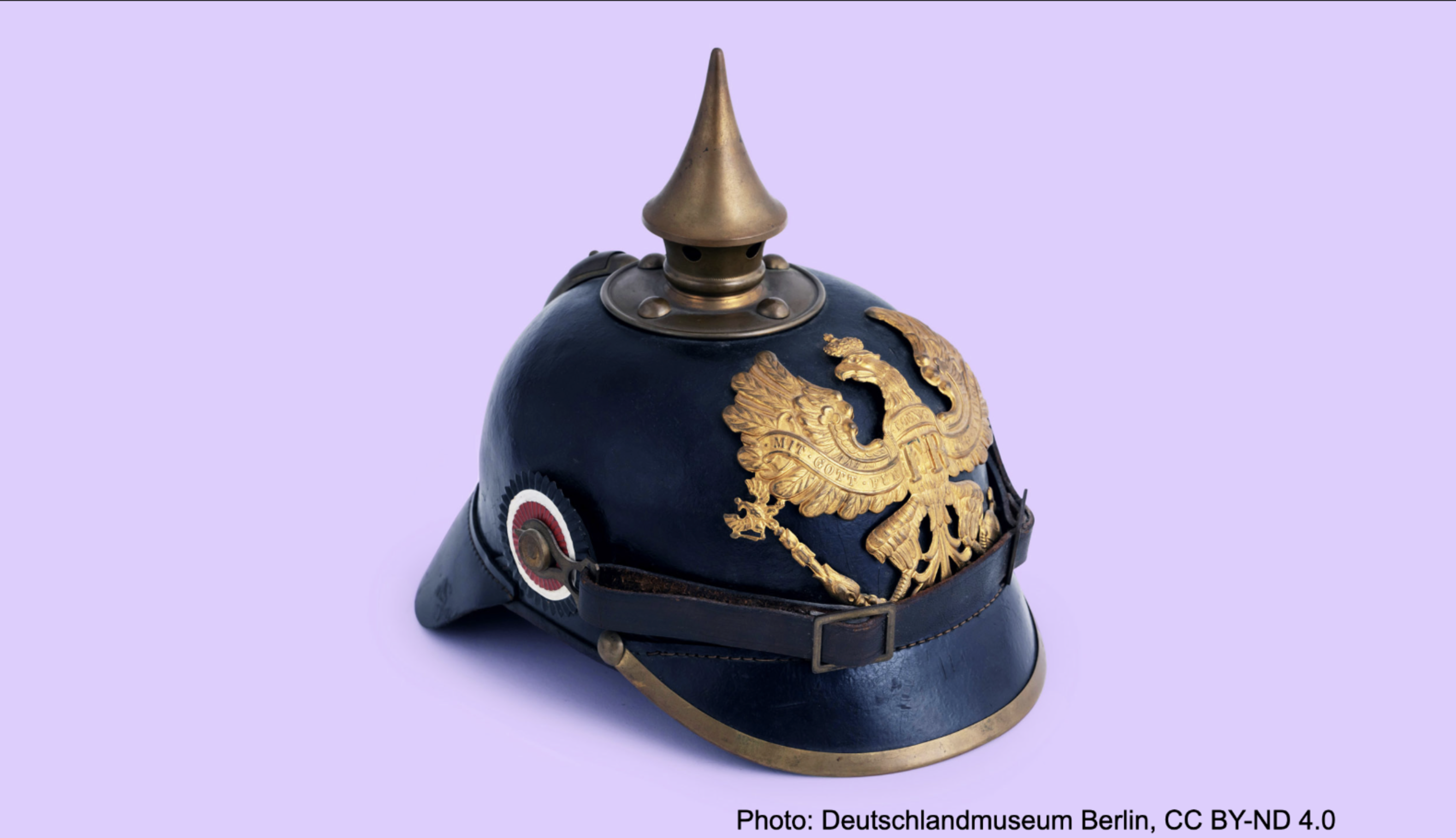 Pickelhaube — Prussian spiked helmet. Photo: Deutschlandmuseum Berlin, CC BY-ND 4.0
S: Let's go back to the obsession that became the foundation of the band. How did your interest in WWI start?
D: It didn't start sharply — it pulled at me from somewhere, accumulated. I watched films, read books, my dad or grandfather would tell me about my great-grandfather who fought in WWI and had medals. "Great-grandfather had medals? What kind?" — "Tapferkeitsmedaille, a cross for bravery." Late eighties, early nineties. And I thought: "So great-grandpa wasn't on our side?" (laughs) It turned out great-grandpa was very much on "our side" — but with nuances. Then a whole family line opened up: his uncle Oleksa, who served on the Italian front. I found his commendation papers and a record of his wounding. I dug up, as they say, "historical kompromat" on my own family. All of this captivated me. I was constantly digging through history books, through WWI. It always struck me with its absurdity — laying down a million people to take five hundred metres of land. Unfortunately we've lived to see such times ourselves. Then I got pulled into what I now call "military archaeology" — back then we just called it diggers. We immediately focused on the military angle: combat operations, the Galicia Division. It started with the Brody Pocket — and there I began finding WWI artifacts: an ID tag, a small medallion with an eagle, an Austrian soldier's death tag, buttons. I realized this interested me far more than WWII. I started visiting museums, buying books, collecting militaria — buckles, buttons, medals, helmets. At some point I had a lot of it. Then I got rid of all of it, but I had that Plyushkin mode going then too, just for militaria. It sounds bad to say "I love WWI," but I don't love the war — I love all the environment around it, how it developed, the aesthetic of each of those armies. Those Pickelhauben, damn — you pick up a pickelhaube and... the sheer awesomeness of it. (laughs) There are no other words. The pinnacle of aesthetics.
S: WWI was where that transition happened — from aesthetic form to pure functionality. By WWII the aesthetics were mostly gone.
D: How were they gone? What about Hugo Boss! (laughs) That's the pinnacle of haute couture.
S: So much new weaponry and technology was tested in WWI.
D: Field-tested. It was coming — humanity had to try things out. WWI was going to happen regardless. Without Princip, with Princip, without Ferdinand or with him — it didn't matter. They would have found another excuse. The Balkan Wars of 1912–13 had already lit the fuse, all that was left was a trigger. And before that — wars with Turkey. The empires had received an enormous number of new technologies: massive cannons, battlecruisers, dreadnoughts, aviation, machine guns. You invent a machine gun — how do you not use it? Browning worked so hard for a reason. Maxim worked so hard, built all that water-cooling — it needs to be field-tested.
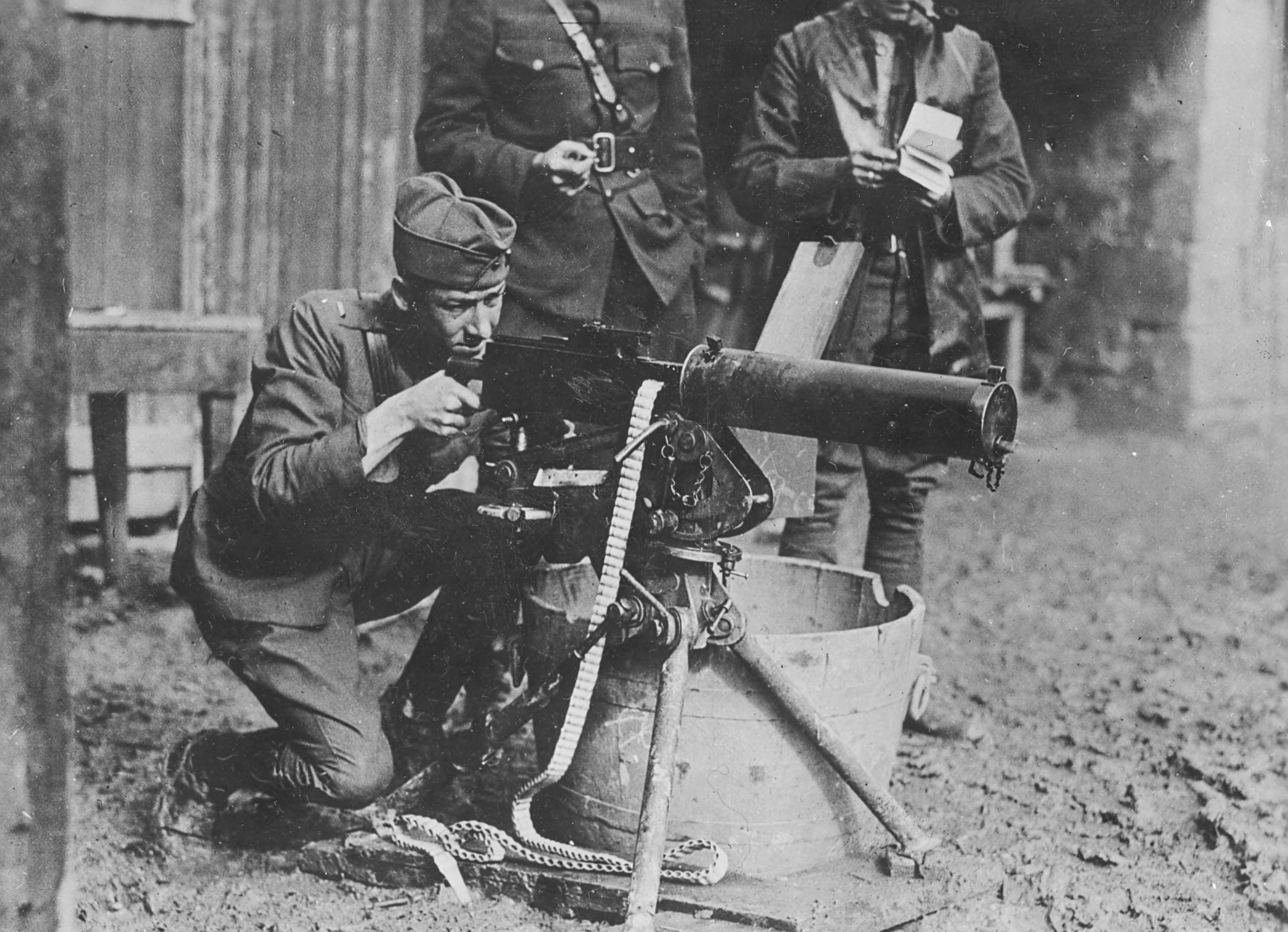 Browning machine gun in action, WWI era
The British tried it in the Anglo-Boer Wars, but barely. How many Boers were there? You need scale.
S: Especially given the name — "Boers" literally means "farmers."
D: Exactly. You set up two machine guns, mow down the Boers — great, hurray! But you want to go further, deploy aviation, send out the battleships, cruise around in submarines with torpedoes. And the guns — enormous mortars, 308, 305 millimetre calibre... oh! Everything was working toward destroying each other — and it had to happen.
S: And tanks, and chemical weapons.
D: Why invent things and not use them? Why let them sit there?
S: We mentioned the Military History Museum in Vienna.
D: There's a whole pavilion of tanks — enormous. I photographed there once. And there's the only surviving prototype of an experimental Austrian tank — built in Lviv in 1911, designed in 1909.
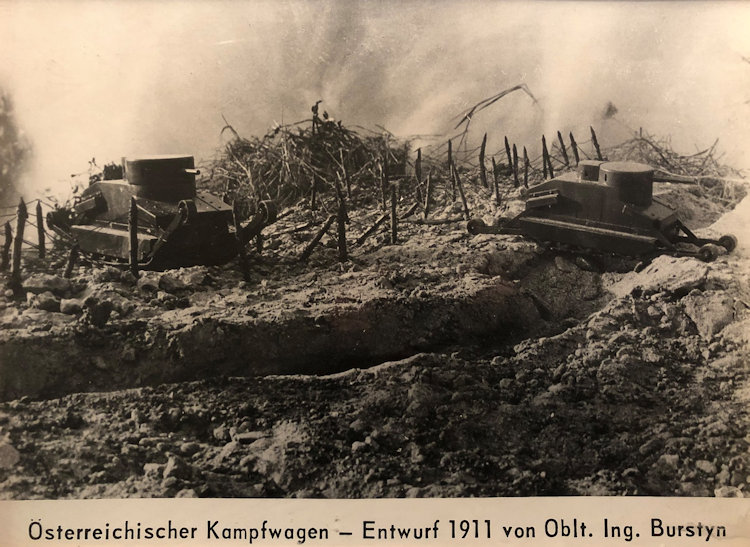 Burstyn Motorgeschütz — the Austrian tank prototype designed in Lviv, 1909–1911
It looks like a contraption from the outside, but it fulfills its function: tracks, little arm-things that would flip over barbed wire, a small gun. Functionally — it could have worked. If the Austrian command hadn't been such narcissistic idiots, they would have scaled it up immediately — and by the time of WWI there would have been no capture of Lviv, no capture of Galicia, no Carpathian campaign. Everything would have gone differently. But they laughed at it and shelved the idea. Now it stands in the museum as an artifact.
S: In the same museum there's a hall dedicated to the assassination of Franz Ferdinand. I got goosebumps — there are newspaper clippings, and one of them is from Chernivtsi. The car, the couch, the uniform jacket with the bloodstained wound track. What emotions did you have visiting that hall?
D: Honestly — that specific hall with the car and the bloodstained tunic didn't move me to the core. What got me were the artillery halls. When you walk through — those mortars, those cannons. You understand just how much the entire human brain, all resources, were running at maximum. For what? To destroy each other. For fuck's sake, seriously? (laughs) They couldn't have invented some spaceship and gotten the hell off this planet — to colonize wormholes somewhere, something? No — building cannons. It always blew my mind in these military museums: how much passion, resources, energy, money was spent just so some phallic symbol could fly out, sail through the air, and kill as many primates as possible. Jesus Christ.
S: Well, we — humanity — have always been very good at that. The very internet we're using right now for this conversation is a military invention.
D: (laughs) The microwave too is a military invention. And?
S: Less serious question: if you had access to a time machine — what year and place would you want to go back to?
D: The Ediacaran period! (laughs) Six hundred million years ago — nobody's there, everything's empty, no cattle, no mosquitoes. The Ediacaran biota crawling around — and that's it. Brilliant! Or — Snowball Earth: when cyanobacteria covered the entire planet for three hundred million years and caused a collapse, and the Earth froze over. Also great. Going back to any period and communicating with people again — no. Seriously though — I'd want the Permian period, specifically the middle Permian, to see the fauna that went extinct after the Permian extinction event, after the Siberian Traps. 96% of species gone, some 99%. I'd want to see them alive. Gorgonopsids, for example. That would be fascinating.
 Permian period fauna — the world Dmytro would visit in his time machine
Everything else — no. Pompeii, WWI, the French Revolution, the Crusades — they can all go to hell, good lord! Stupid, stinking, shouting and killing each other. What's new?
S: Quite a misanthropic answer. (laughs)
D: Such is life.
S: The band name — when you came up with it, did you think about the marketing angle? If you look at any band list alphabetically, you're at the top — numbers come before letters.
D: Nobody thought about that at all. When I said the band would be 1914 — I'd already had a 1914 tattoo on my arm for years, in honor of WWI: a cross, soldiers. We were already playing music, had two or three tracks. I said: "Let's name the band 1914." The musicians: "What is that?" Me: "My grandmother's birthday, the year she was born." They: "Oh god." (laughs) And so it went. I was absolutely convinced that the WWI theme — I had a previous band about WWI, STALAG 328, we even released "Die Kriegsfreiwilligen" — was needed by nobody but us. I figured the musicians would lose interest soon. Because what the hell is WWI, what's the Dardanelles operation to anyone? When I'd dump all of this on them, they'd sit there: "Oh, god." (laughs) And then suddenly it blew up — and great. That was never the goal. The goal was to record an album combining the music I wanted: back then that was black and sludge. I really wanted to play some noisy, screaming sludge with elements of DARKTHRONE. Musically it didn't turn out that way — something of our own came out, something different. And tie it to WWI, which I burn for.
S: Thank you for today's conversation. Any final words?
D: Let's skip the "final words" — this isn't an execution. (laughs) Final words are for the electric chair or the firing squad, where they might even feed you. Let's skip that.