
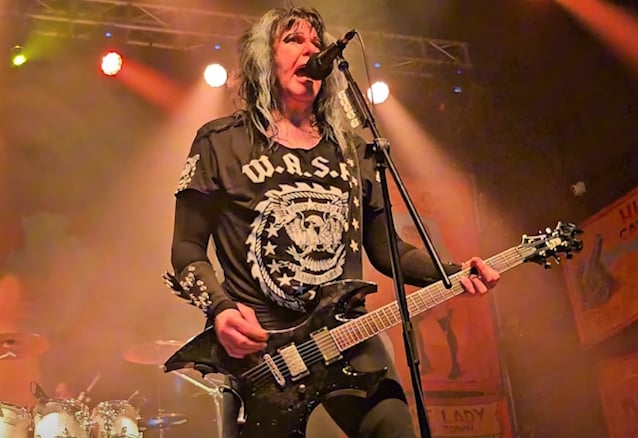
Blackie Lawless has offered his most measured account yet of why W.A.S.P. and guitarist Chris Holmes went separate ways, and it comes down to a record Holmes was never going to play on.
Asked by Scott Penfold of Loaded Radio whether he wishes things had gone differently, Lawless said: "Chris is a great performer. But he wasn't able to do musically the things that I wanted to do later on. And it really was reaching a point of saturation where… You hear the old expression, 'Well, we split up because of musical differences.' Well, it really was that."
The turning point, in his telling, was 1989's "The Headless Children" — and what came after it. "Once we did 'The Headless Children', I'd gone as far as I could go. To ask him to do 'The Crimson Idol', to be Bob Kulick? No. And that's not to put him down. It is what it is."
Lawless also rejected the romantic idea that friction between the two men powered the band's early records. "No, because in the very beginning, there was a chemistry. And it was with all the members of the band. It wasn't just him. It was all of us." He identified the real fracture as the departure of original drummer Tony Richards: "When we lost Tony, we were seriously damaged, and we knew that."
That loss, he said, shaped a decision fans have probably noticed without knowing the reason. "We tried on the second album — well, second and third album — to push me forward. And if you notice, after that third album, we felt that it wasn't working, and we needed to go in a new direction. From that point forward, you never saw any bandmember ever on the cover of an album again. And it was for that reason."
On regrets, he reached for Frank Sinatra: "'Regrets, I've had a few, but then again, too few to mention.' That really is where it sits at the end of the day. The music is the most important thing, and at the end of the day, that's really gonna determine whether the band lives or dies."
A reunion is not on the table. "Well, I would have to turn my back on the band that I have. And to do that… I've been with these guys for over 30 years, and this is the band that I know. And I just couldn't do that."
Holmes, for his part, shut the door harder this past May, telling Thomas S. Orwat, Jr. of the Rock Interview Series that unresolved publishing money makes any return unthinkable. He recalled earning $500 a week while drummer Frankie Banali took $1,850, and said he was classified as a session player.
Source: blabbermouth.net