
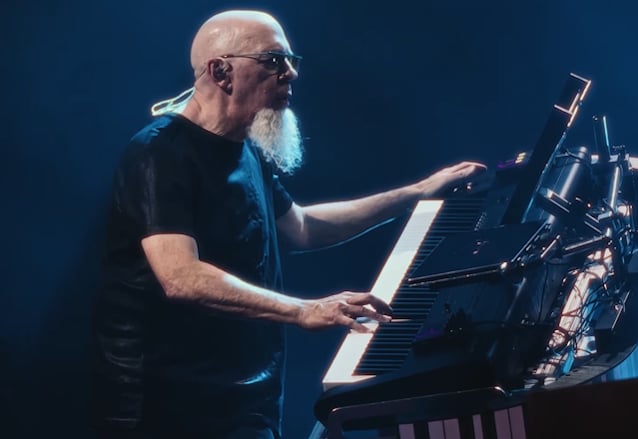
Jordan Rudess will give the first public performances of jam_bot on Saturday, October 3 at MIT — a system he has spent three years developing with the MIT Media Lab, trained on his own playing.
The description is more specific than most artificial intelligence music announcements manage. jam_bot is a model trained on Rudess's style that listens to him in real time and responds, generating musical material that other musicians on stage can then perform. It also writes for singers mid-improvisation. The point is not generation in the abstract; it is a machine that has to keep up, live, with someone playing.
"I can improvise, follow an idea in the moment, and suddenly have a choir or an ensemble responding to what I'm playing," Rudess said.
The work came out of his residency as a Distinguished Visiting Artist with MIT's Center for Art, Science & Technology, in collaboration with Lancelot Blanchard, Perry Naseck and Professor Joseph A. Paradiso of the Media Lab's Responsive Environments group.
There are two performances, at 5:00 to 6:00 p.m. and 8:00 to 9:00 p.m., at the Thomas Tull Concert Hall in the Edward and Joyce Linde Music Building, 201 Amherst St, Cambridge. Capacity is 300 per show. Tickets are $5 for the MIT community and $10 general admission — which, for a first public demonstration of a three-year research project by the keyboard player of DREAM THEATER, is not a serious barrier to entry.
The context is worth stating, because artificial intelligence in metal has mostly meant argument rather than instruments. The discussion in this scene has been dominated by generated album covers, generated vocals and the question of who does not get paid — a debate where the technology arrives as something done to musicians. jam_bot is the other case: a tool built by a player, trained on that player, that does nothing unless he is at the keyboard.
Rudess joined DREAM THEATER in 1999 and has been the band's keyboardist across every album since "Scenes From A Memory", most recently on their reunion with Mike Portnoy. He has spent much of the last decade building instruments and software — the GeoShred app among them — alongside the day job. This is the largest of those side projects to reach a stage.