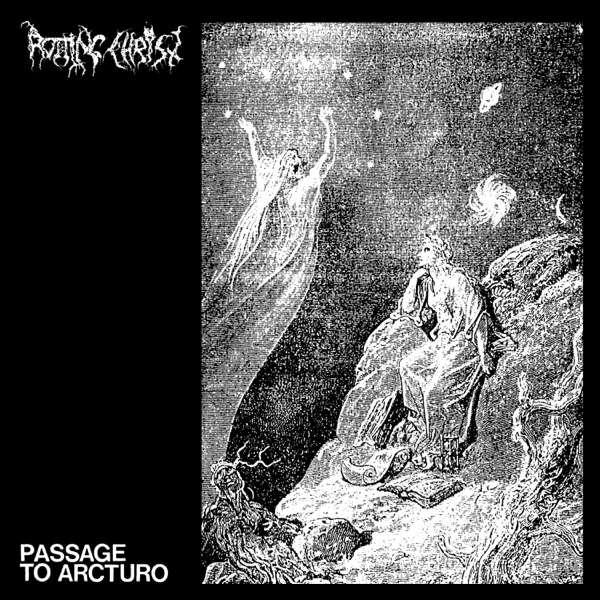
Before us is a unique disc. This is not simply a reissue but a kind of compilation. ROTTING CHRIST fans now have the opportunity to hear how it all began. Formally, the EP "Passage to Arcturo" appeared in 1991 and can be considered the band's first studio work — prior to it there were only demo recordings over the course of several years. However, there was another EP, "Dawn of the Iconoclast," which contained just two compositions totaling 8 minutes, but until now it had been impossible to hear these tracks on CD. The disc before us includes all 5 tracks from "Passage to Arcturo" (only the intro is excluded), both tracks from the EP "Dawn of the Iconoclast," as well as one song from the demo recording "Satanas Tedeum," created in June 1989. That demo was released on CD in 1994 in a very limited run.
So, the first five tracks forming "Passage to Arcturo." "The Old Coffin Spirit" is a death metal composition, and that is precisely what it is despite the rather raw sound — death metal. The same cannot be said of the second track, "The Forest of N'Gai," which is a distinctive interpretation of black metal in the vein of BATHORY. "The Mystical Meeting" even leans toward death-doom, although that genre was only just taking shape at the time — but musically there is no other way to describe this track. "Inside The Eye Of Algond" is the only one that approaches what we would hear from ROTTING CHRIST in subsequent years. Between them there is also a short, predominantly keyboard-driven atmospheric piece with spoken word in Latin. Such was the EP that first brought the band to prominence.
The two tracks from the EP "Dawn of the Iconoclast" are valuable primarily because they allow us to become more closely acquainted with how the band played death metal. Incidentally, the demo track, which is the earliest chronologically, has no relation to death metal whatsoever. In terms of guitar tuning and atmosphere, it is black metal — very slow, solemn, and dark.
Today these compositions may not hold much standalone musical value. On the other hand, one should not forget that this was 1991 and this was Greece — not Norway, not Sweden. And it is an utterly unique fact that it was during this very period that ROTTING CHRIST began building their stature, and to this day they remain the only Greek band to have achieved recognition on every continent.