Season of Mist has never been easy to pin to one genre. Scroll the catalog and you'll find Norwegian black metal veterans sitting a few numbers away from Nordic folk ritual, French avant-garde, Greek symphonic death metal. HOLISSSTIK turns up with "Dark Electronic" printed on the promo sheet, which is the least useful thing anyone could tell you about it. It's music, and it doesn't need a subgenre to hold it.
Behind it is Tor-Helge Skei, who started MANES in Trondheim in the early nineties and has spent the thirty years since undoing whatever that beginning implied. Vilosophe in 2003 was the turn, the record where MANES stopped being a black metal band and became something nobody has since managed to categorize. He hasn't slowed down: LETHE with Anna Murphy, HØSTSOL alongside Niklas Kvarforth and two Finnish players, MANII with his original MANES vocalist, plus SYNING and KKOAGULAA with P. Emerson Williams. HOLISSSTIK casts wider than any of them, and it's the first of three planned albums.
Seventeen contributors turn up across eight tracks. The promo copy sells this as a gamble that might have fallen apart, though the credits suggest otherwise. Skei wrote and arranged everything, recorded it, and mixed it himself. His guests were coloring inside lines he'd already drawn, some of them sketched a decade or more ago. The range is genuine even if the risk wasn't quite as wild as advertised.
That's also why it holds together. Forty-six minutes, nothing over seven, and at no point does it feel like a compilation. Records with this many guests usually bloat past seventy because every contribution has to be honored. Someone here was willing to cut.
"The Rhythm of Silence" works as a lure. It's the longest track and the most crowded, seven contributors deep, and somehow also the calmest thing on the record: a trip-hop base with electronic rock coming up through it, and a hip hop passage from Pierre Ripka in French. Marita Hellem and Martyna Halas sing across the top. Seven minutes to draw you in is a slow way to open an album, and clearly deliberate.
"My Salvation" stays electronic and pushes harder. Parts of it recall ARCTURUS, another Norwegian band that walked out of black metal around the same time, though here Halas carries the vocal alone. "Projections" is the shortest thing on the album and the only track with no guitar on it at all, Kristoffer Oustad's synth and Nik Košar's voice working unease out of cosmic ambient drift until it thickens into a wall of electronics. "Obsession Six" puts the distorted guitars back, under electronic detail and three voices: Gabriel Trentini, Tom Engelsøy and Anna Murphy.
"Reoccurring Dreams" runs Košar through a robotic filter and packs guitars and synths around him thick enough that it starts drifting toward black metal and ambient at the same time. Put it next to "Projections" and you can see what Skei is doing with him: same voice, opposite surroundings.
"Would You Take This Heart" caught me off guard. Halas opens in Polish, near enough to Ukrainian that I understood it before I'd registered I was translating. "My heart is no one's, whose heart is mine?" That's an unsettling way to be let into a song. It moves out of her ethereal singing into something harsher and comes back to where it started, with Buddhist monks chanting in Pali somewhere in there. English, Polish and Pali inside five minutes fifty.
Then "Behind Me" breaks formation, and it's the best thing here. Siren-like sound, unease building, Christophe Denhez pushing his voice to the edge of a shout over lyrics he wrote himself. It's the tensest and most energetic track on the album and also the least constructed: Rune Hoemsnes drumming instead of Tor-Arne Helgesen, Torstein Parelius on bass, two guitars, one voice. You can hear a rhythm section in a room. It isn't a one-off, either. Helgesen plays the first six tracks and disappears for the last two, Parelius shows up on exactly those two, and the album swaps out its engine for the finish.
The title track closes with no drums on it whatsoever, which is why it lands as a long calm outro instead of a song. After "Behind Me" it's lighter, warmer, and there's something like hope in it. Hellem and Halas sing together here for the first time since the opener, and they don't appear together anywhere else on the record. It comes back to the two voices it started with.
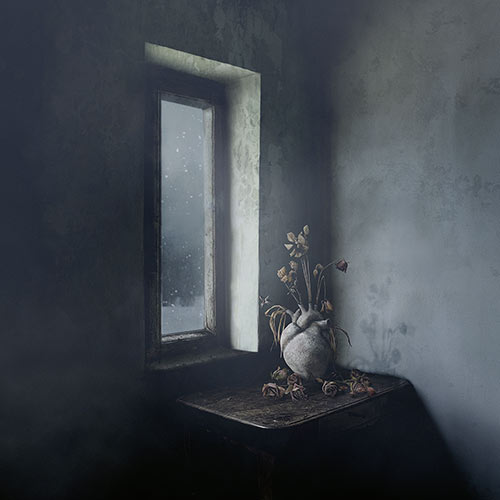
Knut V. Prytz, NECROPHAGIA's guitarist for eight years and now Skei's usual mastering choice, keeps it all legible at volume. Adrien Bousson's cover, wilted flowers, tells you roughly where this is heading before you've heard a note.
If Chapter I is the opening of a trilogy, Skei has set himself a hard standard to follow.
Promo provided by Season of Mist.
Links: