
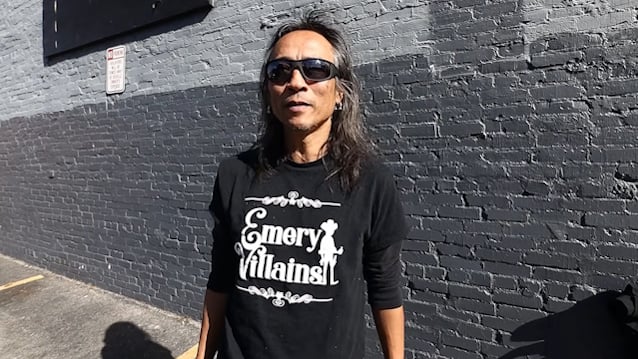
DEATH ANGEL guitarist Ted Aguilar has voiced a concern that many long-time metal fans quietly share: the progressive homogenisation of the genre's contemporary output. In a recent interview, Aguilar reflected on what made the classic 1980s Bay Area thrash scene so instantly identifiable — and what he believes today's bands are missing.
"I can't tell who from who," Aguilar said bluntly, contrasting modern metal's undeniable technical proficiency with what he sees as a critical absence of individual character. "You had to figure out, you had to be a band together" — a comment aimed squarely at the shift away from developing chemistry through in-person rehearsals and joint songwriting sessions.
Aguilar draws a clear distinction between two eras of creative process. The old model saw musicians lock into a rehearsal room and organically develop a sound inseparable from the personalities involved. The modern approach increasingly has individual musicians contributing parts in isolation before the finished product is assembled remotely. While acknowledging that technology enables previously impossible forms of collaboration, he argues it fundamentally cannot replicate the "human contact" that generates genuine musical identity.
The observation carries particular weight coming from a member of DEATH ANGEL, one of the original Bay Area bands that emerged alongside METALLICA, EXODUS, and TESTAMENT. During that era, each outfit developed a distinct sonic fingerprint through intensive, in-person work — and the differences between them remain immediately recognisable decades later. DEATH ANGEL's own progressive, technically demanding thrash was a product of exactly that process.
Aguilar is not dismissing the technical abilities of current players — he explicitly acknowledged them — but his argument is that technical mastery without a coherent, collaboratively forged identity produces music that registers as competent but interchangeable. It is a critique that echoes concerns voiced by veterans across the spectrum, from JUDAS PRIEST to SLAYER: that the sheer volume of contemporary metal has produced a sea of capable but characterless acts.
The challenge for today's bands, perhaps, is finding ways to build that chemistry in an era where geography, economics, and working habits push musicians toward isolation. Whether any of them are meeting that challenge is a question Aguilar left pointedly open.