Scorpio: It's been five years since Savigaila, and you've described that gap as a deliberate pause — time to think through what the music was actually for. Where did that lead, and how did Epigrama come together?
Vaidotas: It's been a while since the last record, that's true. In that time we actually recorded a full album — I think it was 2023 or 2024, I don't remember exactly. We made what I'd call a demo for a new album, and it had a lot of interesting ideas. Some of the songs were genuinely good. But we decided to scrap it.
That's an unusual thing to do, because you're trying to catch a certain feeling and put it into the album — to portray your emotions and the things that are important to you at a certain point in your life. So it was an unexpected decision, even for me, to get rid of most of that music. It was around 50 minutes of recorded material. But I looked at it very critically, and it felt like something was really missing. It was lacking a little bit of sincerity, in my opinion, musically. So I decided to give it a creative pause — a year, no more than two — and focus on finding the things I, and some of the other guys, actually enjoy about playing and creating music.
That led to a really nice realization: we were enjoying the rediscovery of what it means to make music. I saw how important it is to give yourself time and reflect on why you play, what it means to you, how you want it to sound — and not just in terms of songwriting, but production and sound design too. Over the last few years, me and especially our guitarist Adomas spent so many hours in the studio, basically like in our teenage years — playing with production, learning new recording techniques, realizing you can blend things to make the sound as heavy as possible, or turn instruments into soundscapes. That empowered us to make better music, the kind we'd be proud to put out.
And to be clear — that earlier batch wasn't really a demo. It was almost fully produced. I was about to deliver it to a label. But I think scrapping it was the right call, because now I can strongly stand behind every single song we wrote for this album: the way it sounds, what it means, the whole flow. It was important to reset, re-establish what's actually important, because music is a huge part of my personal life.
 ERDVE
ERDVE
Were you able to reuse any ideas from those scrapped 50 minutes, or is Epigrama completely different?
I recycled some of them. We had about ten songs there, and each one had a really good hook. I used those as a basis to reinvent and recompose some of the arrangements — but I ended up switching tempos, tunings, the tone, everything, and it became an entirely different thing. So it served as a writing template, a basic idea to start from. It wasn't completely disregarded. But if you could listen to that demo and then this album, I don't think you'd recognize a single part.
That's just how my creative workflow goes — and not only with music, but with all kinds of work. You have some framework to start from, then decide whether to keep any of it. The ideas don't only come from the old material, either; they come from hearing other artists, soundtracks, a whole array of genres — anything that sparks something. So I had a lot to work from. It wasn't a totally clean start.
This is the first ERDVE album where Adomas co-produces with you — on the first two you took that over completely. What changed that made handing over part of it the right move now?
It was just a good fit. We're both very obsessive about spending a lot of valuable time in the studio, and that's hard when everything runs on a schedule and everyone has limited time. Sometimes you plan a session, you brainstorm, you try things, and you end up with no results. It takes a certain passion — an inner drive — to see the value in spending those hours. So Epigrama is really the result of me and Adomas working every single song, rewriting structures, trying different ideas.
He especially helped me with tracking vocals, which is very difficult to do by yourself — something I used to do, because I really enjoy the learning process of doing everything myself. I wouldn't call it being a control freak; I just enjoy getting to a result on my own. Adomas joined a few years back — two or three years ago — and ever since, we've been completely in line in terms of vision. He challenges my ideas, I challenge his, and it's all about structuring the song as well as we can.
Actually, "Epigrama," the title track, was the first song we wrote for the album. At first I thought it wouldn't fit the concept or the sound of ERDVE at all — it seemed like a completely different genre. But we worked it out in the band's favor, and after collaborating with him I had the confidence to put it on the record. That kind of collaboration takes a certain character and motivation. We're both really into learning production, so we did everything ourselves — honestly, I think we spent more time mixing, mastering and messing with the tracks and settings than we did actually writing the music. That says a lot.
In your own ears, what's the biggest difference between Epigrama and Savigaila? And Savigaila had that unusual piano piece near the end — will there be anything like that this time?
This time, no. We tried to be really straightforward with the songs — to concentrate on songwriting, on actually writing songs, instead of writing riffs and stitching them together into a song. That was a completely new approach for us. We emphasized song structures; the songs have choruses, even if they don't sound like traditional rock or metal choruses. We looked at it more as world-building and storytelling, so everything is in line — the lyrics, the riffs, the structure all tell a story and work hand in hand.
Before, to be honest, I wrote and recorded to the best of my knowledge, mostly based on feeling. We used to describe our music as based on raw expression, and that's exactly what it was. Other bands come together, improvise, assemble a song brick by brick — I used to just feel it out and hammer it out, especially when I was in a terrible mood after work, harnessing that energy into something that sounded the way I felt. That led to long, repetitive, sometimes monotonous songs, a lot of experimenting with noise. It sounded exactly like my life was at the time.
Now we're much more structured — the band is almost ten years old, this is the third album. Production and songwriting are procedural nuances, if I can put it that way. The main thing is a clarity I didn't have before: I can envision something in my head instead of just feeling it. I can hear the whole song in my head before I even start writing or structuring it. I notice the same in other areas of my life — when you do something long enough, you become a sort of, well, I wouldn't say expert. In some fields I would — in my work, I'm also a photographer, so by now I know what I'm doing. Music is more emotional, more expressive, so I won't call myself an expert, but I can express what I envision much more accurately.
Maybe someone would call that creative maturity. I don't know — it's my first time living a life [chuckles]. Maybe a lot of musicians feel that way after fifteen or twenty years, when they realize, "Okay, this is what I like, this is me." I think Epigrama sounds about 85% the way I'd want it to. There's still more to improve in the whole process.
 ERDVE
ERDVE
Let's talk about the other creative side — the lyrics. ERDVE's words are pretty philosophical, and according to the press release, Epigrama frames every decision, and even every non-decision, as a kind of moral debt. Where does that framing come from?
I actually think I read it somewhere — I don't remember exactly where, but I'm pretty sure it was a physics-related documentary I watched about universal entropy. I think it was one of those audiovisual "timeline of the universe" videos on YouTube — not a real documentary with scientists, but something that fast-forwards from the beginning of the universe through millions and billions of years. I'm not a physicist, so I won't pretend I understood all of it, but there was this depressing idea in it. I'd actually forgotten where it came from until you asked — so I'm glad I remembered.
Basically it said everything in the universe, energy-wise, is bound by the laws of entropy, and everything is destined to descend into chaos and nothingness. They were asking when time ends, on the scale of the universe — when the very last photon of light disperses, which is going to happen inevitably. It made me a little sad, because it turns out everything is slowly eroding over time, starting with us — we get older, and so does everything else in the world and the universe.
I don't want to come off as some doomsday person — I'm not — but the idea that there's no happy ending really gets on my shoulders sometimes. That's in the grand scheme of things; we obviously have more grounded problems to solve, and that actually helps me appreciate things. But it's an exploration of how entropy and the deterioration of everything reflects on me, and I'm a little troubled by it, so I wrote about it. Every song, including the title track, is sort of about that — but framed through life situations, the way you feel about things mentally and psychologically. I think a lot of people can relate. It's the devastating truth of entropy that inevitably touches us, depending on what's important to you: relationships, health, people gone from your life, the people you see dying on the news. People as a whole try to create an illusion that there's structure and control, that everything's fine. I just don't feel that way, so [chuckles] that's what I sing about.
Does that help you enjoy the present, rather than fixating on some big happy moment in the future?
A little, but it was more about what music is actually for — expressing your feelings at the time you write the song. The interesting thing is that when I was writing the lyrics and the music, everything came together without me even realizing it. The same with the music videos for "Nira" and "Idos," the first two singles — it all came together so easily, like it was somehow premeditated. It starts with the music, then I write lyrics for it; not by listening every ten seconds and writing a neat sentence, but more like poetry. You think about it, let it flow, end up with a bunch of text, and eventually fit that text to the song structure.
So I think it just needed to come out. I'm not sure it makes me feel better, honestly. We were in the studio yesterday with Adomas working on another project, talking about new music we already have, and it already sounds different. I said, "I can't even listen to this album anymore" — I've been listening to it for two years, and it has a feeling I kind of want to get away from. I canned that feeling into an album, and now it's a bit hard to listen to. But when they say music is something for you to release your feelings — that's exactly what happened. Maybe once I achieve some things, or get into a different headspace, I'll be able to listen to it again and enjoy it more as an art piece.
You write in Lithuanian. A lot of rock and metal bands face that choice — go English to reach an international audience, or stick to your native language. How was that process for you?
We've had a lot of questions about it from our audience lately. We tend to talk with them privately quite a bit, which is a cool thing — they ask, "What the hell are you singing about?" and write comments like, "I can't understand a word, but I can feel it." For us, it started simply: we love our language, we love our country, and we think we can be more authentic, emotionally, singing in our own language. The other natural option would be English, and I'm not going to sing in a language I don't speak.
Compared to Lithuanian, English — and maybe someone will strongly disagree — in terms of traditional metal phrasing, the way it sounds, "something dark of something even darker," seems pretty basic to me, unless you go full Shakespearean. If you want to say something really strong, I don't think English has the capacity for it. Lithuanian has a strong color to it. That said, I don't consider myself very literate even in my own language. I've had feedback like, "Why are you messing around with the words? Why not use the correct words correctly?" — because I like to blend words and make up my own that sound a certain way. People understand; it's a common thing to play with words, to have these strange sentences that sound harsh just for the sake of sounding harsh, not for the sake of being grammatically correct.
We have quite strict rules about the language here, because we want to preserve it. There's a problem where people use an English word every second word now, especially in work environments — or they take an English word and give it a Lithuanian ending.
We do exactly the same in Ukrainian, so I completely understand.
Yeah. But we never use anything like that in our lyrics. I try to be as poetic as possible. If I want to say something dark, aggressive or angry, I never use the swear words we use here — most of them come from neighboring countries, and they sound barbaric and a bit too straightforward. I try to make it sophisticated instead. As I said, I'm not very literate and I'd get criticized for it — but ultimately it's music, it's my own expression. If I'm writing lyrics, I want them to feel important to me.
We actually had another discussion in the studio yesterday about language. We've seen some successful examples of bands singing in their local language — like Vildhjarta. The discussion was: if you took everything you understand about how the music industry works, what would be the most successful project — something that could take off in the first year? Just for fun. And we got a bit stuck on whether English would definitely be the way to go. We couldn't reach a definite answer. Maybe accessibility would help, but for this band I can't even imagine doing it in English. I used to do that with other bands in the past, and I was decent at it — the clichés, the philosophical or nasty words, the names of illnesses, especially mental illnesses [chuckles]. You just take a medical book and start singing it — until you become like that yourself.
So in the context of ERDVE it would be really hard to switch, and there's no need. I could experiment, though — we're actually thinking about some collaborations with non-Lithuanian bands, maybe a guest vocalist doing choruses in English, almost like a dialogue. At this point language isn't that big of an issue; it's more about how it sounds. I hear different opinions — some people say the lyrics don't matter that much, it's about emotion; others really want to understand what they're listening to so they can sing along at shows. Our music isn't really like that. When we start playing like Bring Me the Horizon, maybe it'll be relevant [chuckles].
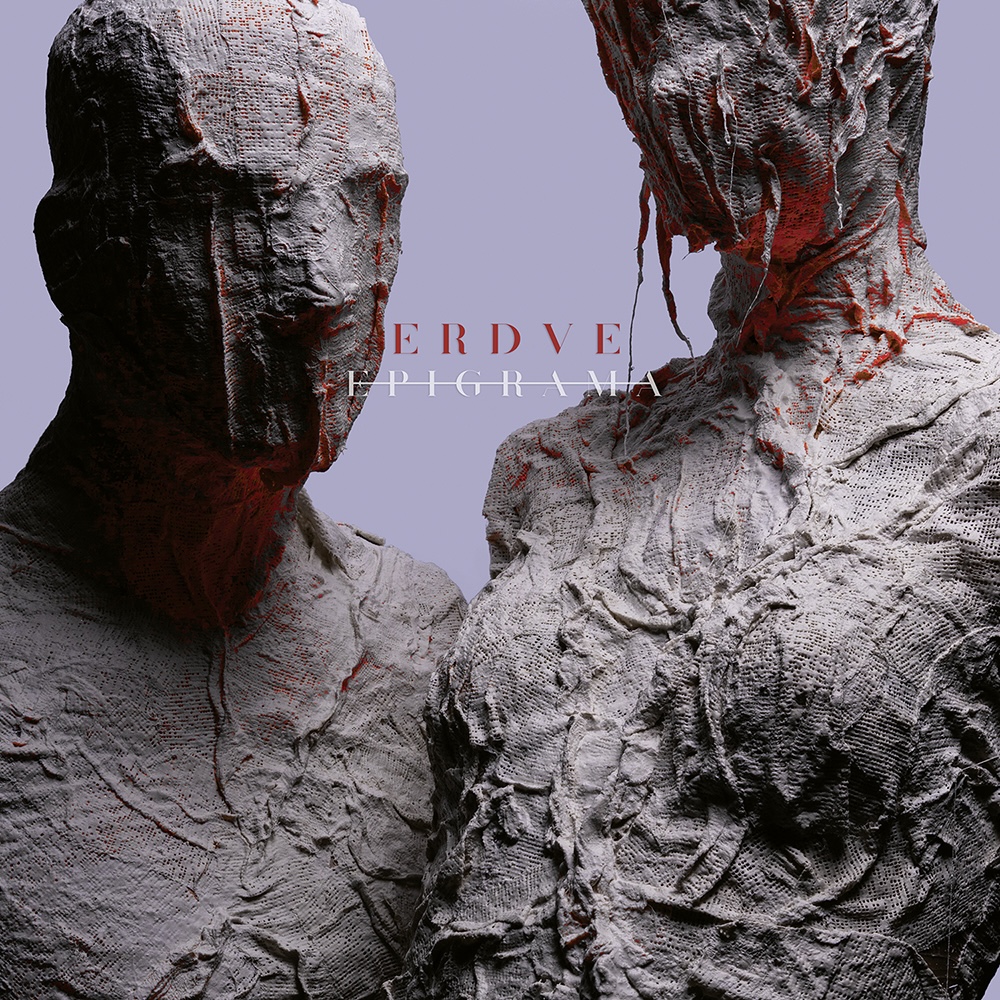 Epigrama (Season of Mist, 2026)
Let's talk about the visual side. You've got a cohesive story across your covers, and in your videos there are these human-like figures wrapped in bandages. What's the history behind them — who makes them?
"Epigrama" is a word that originally meant short sentences written on gravestones — often quite sarcastic citations about life, on a prominent person's grave. It originates with the Greeks. So the whole core of the visual, and the album, is something you can imagine as a gravestone in a graveyard — and not just any graveyard.
The visual comes from my friend Simonas, from the Lithuanian band Luktus. Years ago, when I was traveling to Rome, he recommended I visit the oldest cemetery in Europe, Campo Verano. It's not like the cemeteries we have here — it's monumental, almost a museum. The gravestones, angels and statues are old and weathered by rain, and when the rain hits them they start to look incredible — covered in moss, dark patches, the faces literally melting. That really inspired me, because Epigrama already had this gravestone theme around the word itself.
So the figures we created are basically those weathered statues you'd find in a very old cemetery. We chose to make them from mannequins, applying material to them — I asked my friends Venus and Maria, who are tattoo artists, and they helped me create them. There's a statue for each song, so eight songs, eight statues. We used the plaster they wrap around your arm when you break it. And we really enjoyed making them by hand, because in this world of AI where everything is fake, doing something by hand is unique and cool. I'm being a bit sarcastic, but it's true — we wanted to make it ourselves, like we always have. I photographed everything on the first and second albums too; on the second album we also made all the music videos ourselves. That's our drummer on the second album cover, covered in all sorts of stuff.
That DIY thing matters to me because it keeps everything consistent. It's definitely harder, but I love it. This time we really took our time thinking about how all the graphics should look — we did six photo shoots of the sculptures, outside and inside, improving them, taking them to different settings. I actually finished finalizing the photos today, because we have an album release show in two weeks and an exhibition of those photos, with huge prints at the venue. The visual aspect is really important — and you'll see the artwork in the vinyl, too, which I already have here at home, sitting in three huge boxes. It all ties back to the core idea: those statues won't be there forever. The law of entropy will dissolve them anyway — weather, wind, time. So I really like talking about it, because I'm proud of how it turned out.
ERDVE is also known for playing very interesting venues — a church in Vilnius, and the former Lukiškės Prison, originally built as a Tsarist Russian Empire prison and later used under the Nazis and the USSR. Did you choose those places intentionally?
Thanks for this question — those were two really significant shows. Starting with the prison: it wasn't only controlled by the Soviets — my grandfather actually had the "pleasure" of serving some time there, two years, over something political that was relevant back then. It ended up okay for him; he had a very long life afterward. Because I'd listened to his stories, I always had an interest in the place — the kind of interest where I'd have been afraid to end up there [chuckles] if I did something wrong.
Right now the prison is completely transformed — a stage outside, bars, a club, studios for rent for musicians and artists. It's a very active creative hub in Vilnius, with events almost every other day. But our show was before the transformation. The inmates had just been transferred out a few months earlier, so you could still feel the energy — there were no bars, nothing, it was just a prison. We were lucky; through people we knew, we knew how to approach the place and the people responsible. There was no infrastructure, so it was a bit difficult logistically, but the architecture is very suitable. They have gigs in the same space now — if anyone's listening, look it up: "Erdve at Lukiškės Prison." (https://www.youtube.com/embed/NMQ0DVcyhDg)
It has this round, cylinder-shaped hall, three stories tall, with corridors to the holding cells and these strong nets between the levels to stop people from killing themselves by falling. So you're in this big cylinder, you see layers of nets, and people were watching from all around, looking down — you could see their silhouettes, these dark figures. It was quite creepy having people watch over you from way up, like they might jump any second [chuckles]. The sound was a real challenge — you have to measure the acoustics and place three lines of PA, one on each level, so people can hear. We set up all the lighting too. It was successful. And it was during COVID, the worst possible time to do shows, so we were risking too many people coming — but it ended up fine.
The church is a place where events like that happen from time to time — Swans played there last year, I think. But definitely no metal shows before us. It's near Vilnius University, so it was a little easier to get into than another church might be. I wasn't the one who organized it, but it was a really cool gig — very challenging to set up good sound, but a lot of people came and the atmosphere was great. We did custom lighting for the church instead of the usual interior lighting, which is meant for a completely different purpose — we made it really creepy. For anyone watching, check it out: St. John's Church. I'm really proud of how those videos turned out. (https://www.youtube.com/embed/jxXlhJt11sA)
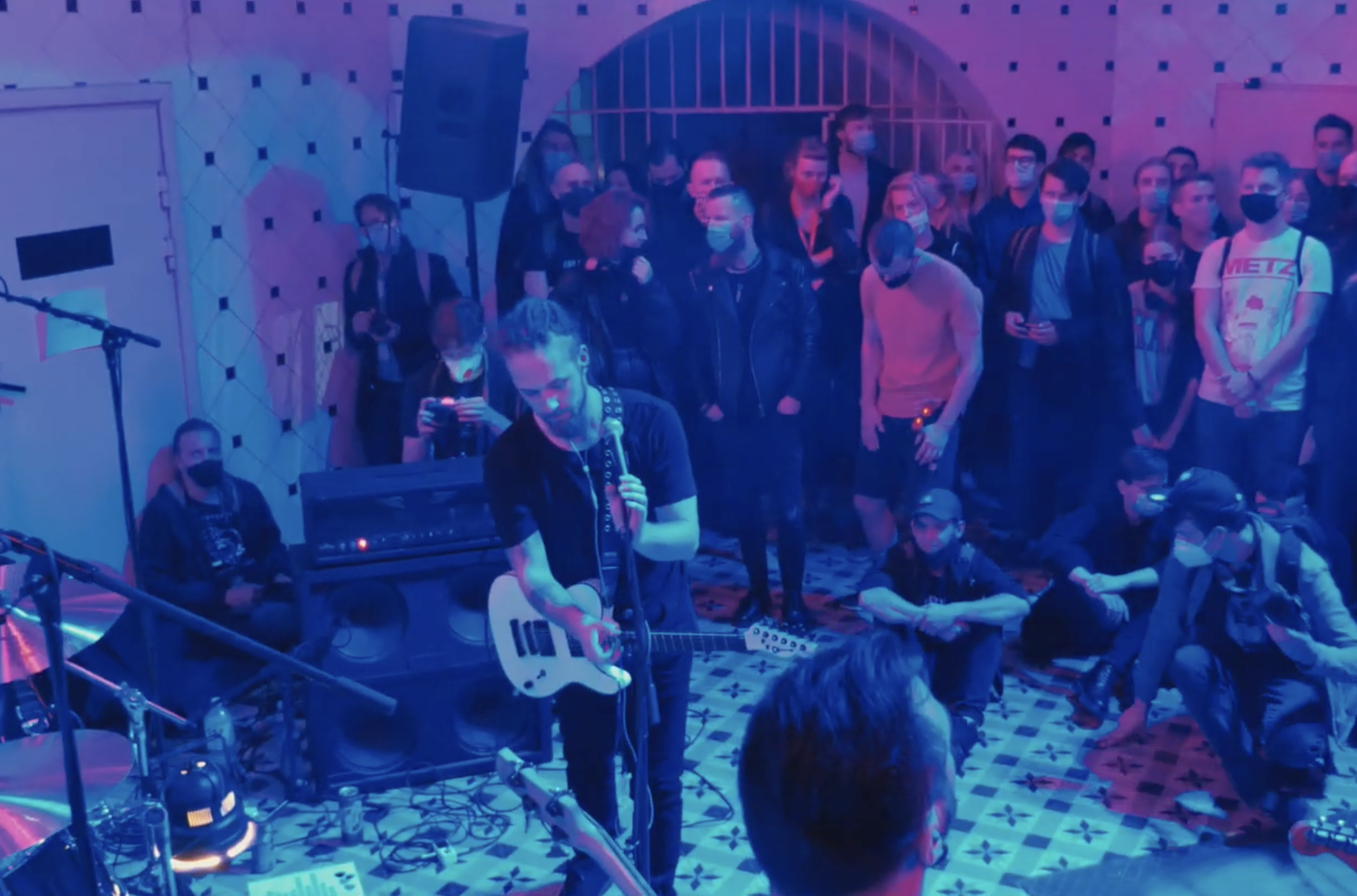 ERDVE live at Lukiškės Prison, Vilnius
Let's stay with Lukiškės. Given your family connection, how was it personally for you — what were your feelings inside those walls?
When we arrived to prepare for the show, we saw some people walking around, carrying furniture, chairs and tables out to a truck. It turned out they were inmates — and not the best ones — kept there to tidy the place up. They were walking right beside us, and we were like, "Who are these guys?" There were still a few guards, so it wasn't a problem, but we didn't know that at first; we thought they were just hired workers. Then it clicked: "Okay, they're still serving their punishment." I'd never been somewhere with sentenced people walking around beside me. It's not Norway, where in some towns they walk around, say hi, drink a beer with you and head back by nine.
We also heard real stories about the place. They do tours like that every week now, so if you visit Vilnius you can sign up and hear the whole dark past of those walls. Because there was no transformation yet, we felt a little like trespassers, and we were concerned about what it might mean to people — someone going, "Why the hell would you play in a prison? What's the point?" I remember when I was a teenager, Metallica played a prison for inmates, and talked about getting arrested once for being drunk in public, so now he knew what it felt like to be incarcerated — it was a little cringe. For us, we tried to approach it respectfully, not to make it, "Yeah, we're in prison, so cool." We were humbled, grounded — "Okay, let's keep it simple, do our thing." We didn't go into the cells and take funny pictures pretending we were locked up, even though we had a lot of free time that day.
And later, Netflix and other companies often used the location for movies and shows. They shot a scene right where we played — there's a nightclub there now — using those small solitary cells, with club dancers on poles. I was like, "Oh, that's a little weird." The scene was literally "former prison, now club," exactly how it is now. But knowing the stories from back then, what they did in those cells, the things my grandfather told me — I thought, I don't want to make fun of this. Let's treat it with respect, use it as historical architecture with a certain vibe to enhance the experience. We were a bit concerned about how to communicate it, but maybe we're just overthinking. Either way, it was a really cool thing to experience. I've been back for a couple of shows since — it's completely different now, with music playing and no silence — but it's a very cool place. If you're visiting Vilnius, check it out; it's quite unique.
It's been a great conversation — we've been talking for an hour, but it flew by. Before we close, what would you like to say to the people watching, the people who'll read this, the ones who know ERDVE, and the ones just discovering you?
I'd invite everyone to watch the music videos we made. We really tried to make them sound good and worked a lot on the music, so every comment and bit of feedback is really appreciated. I hope you'll enjoy it.
I can also say we won't leave such big gaps between releases anymore. Now that we have this creative clarity that was maybe lacking before, we're already working on an EP and singles, so expect new music — we're going to try to be as productive as possible. And if anyone listens to the new album, I'd really appreciate it if you send feedback. I'm a little starved of actual discussion about music, and we're not a very well-known band, so every opinion matters to us — especially if you like it. I've noticed this trend of people writing reviews with AI, and they're often really generic. So any sincere feedback, anything you find in the music — feel free to reach out. If you want to discuss or ask anything, we're here. I'd love to hear your thoughts on the rest of the songs, because every one of them is completely different — its own statement, its own sound and flow.
Thank you so much for your time today.
Thank you, man. Thanks.
ERDVE on the web: Bandcamp · Instagram · Facebook · TikTok · Spotify
Epigrama is out now on Season of Mist.
Thanks to Will Yarbrough at Season of Mist for arranging this interview.
Video version: