Scorpio: Where did the idea for Maurice come from?
Aaron Sammut: I'd been working in publishing for about fifteen years, and I was having a really bad start to the day. I put on "Master of Puppets" by METALLICA, and with every step it felt like the song was making me a bit stronger — pounding the pavement on my way to work. By the time I got there, I had this character in my head: a superhero powered by heavy metal. By the end of that first day my whole desk was covered in Post-it notes with character arcs and stories, and I already had the possessed Walkman worked out. That was twelve years ago now, and I've been working on it ever since, up to issue five.
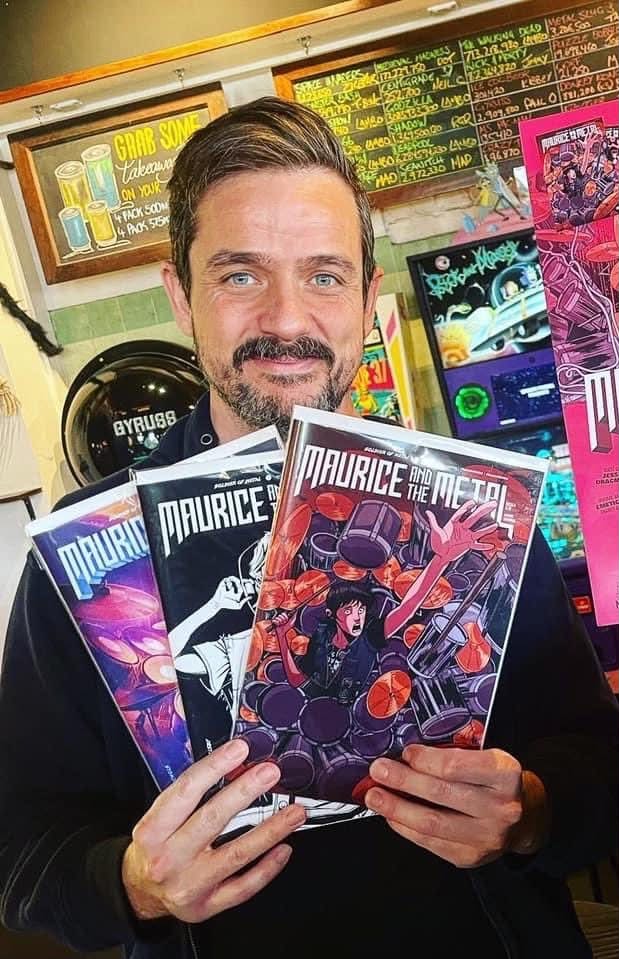 Aaron Sammut with the books — fifteen years in publishing, one bad morning and "Master of Puppets" on the stereo, and Maurice & The Metal was on its way.
What's changed the most about the world of the book since issue one?
The scope, mostly. The more research I did into the Bay Area, the more I realized was actually going on there at the time — bored kids, lower middle class, a lot of genres of music overlapping. Jazz was still prominent, punk was coming through. By issue one it felt like this could be a single character's story. Since then it's expanded into what it's like for someone to get into metal for the first time, alongside Maurice, who's already a metalhead.
Why Kickstarter, and were all five issues funded that way?
The first issue I funded myself, completely. I'd never done anything like it before, and I realized fast this was an expensive passion project — I was going to need some support. Kickstarter seemed like the place to go for comics, so issues two through five have all been funded there. But it only covers maybe a third of the actual cost. The other two thirds comes out of my own pocket, and I couldn't be happier with where that money goes — it goes to creatives, to people making Lego minifigs of Maurice, to variant cover artists from all over the world.
The book has had three different artists across five issues. What was that like?
There have been issues with that, yeah. The first two issues were drawn by Jesse Hamm, an American who lived in Portland. He wasn't available for the third book, and I had to find a new illustrator — I found Nicola Izzo, from Italy. Sadly, Jesse passed away a couple of months after telling me he couldn't be there for issue three. It's sad to see a comic hero like Jesse Hamm go, because he was so good at teaching the community as well as contributing stellar artwork. He set the basis for the character — the first time he drew Maurice, I didn't really know what Maurice was going to look like until I saw Jesse's version of him. He's got a special place in Maurice's history.
Nicola came from a more energetic, modern comic book style, so it was about honoring where the source came from and gradually adding his own flair, rather than jumping straight from one stark version of Maurice to the next. Lauren Marshall has illustrated issues four and five — a fellow Australian. Her style sits somewhere in between, a bit more comedic and energetic than Jesse's. Jesse's style was like the silver era of comic books, something like Archie. Nicola had more of a manga feel. Lauren's got a different feel again. I think as long as the character and the setting stay consistent, the style shifting between artists is a bonus, not a problem. I hope it doesn't read as disjointed, but that's how indie comics goes sometimes.
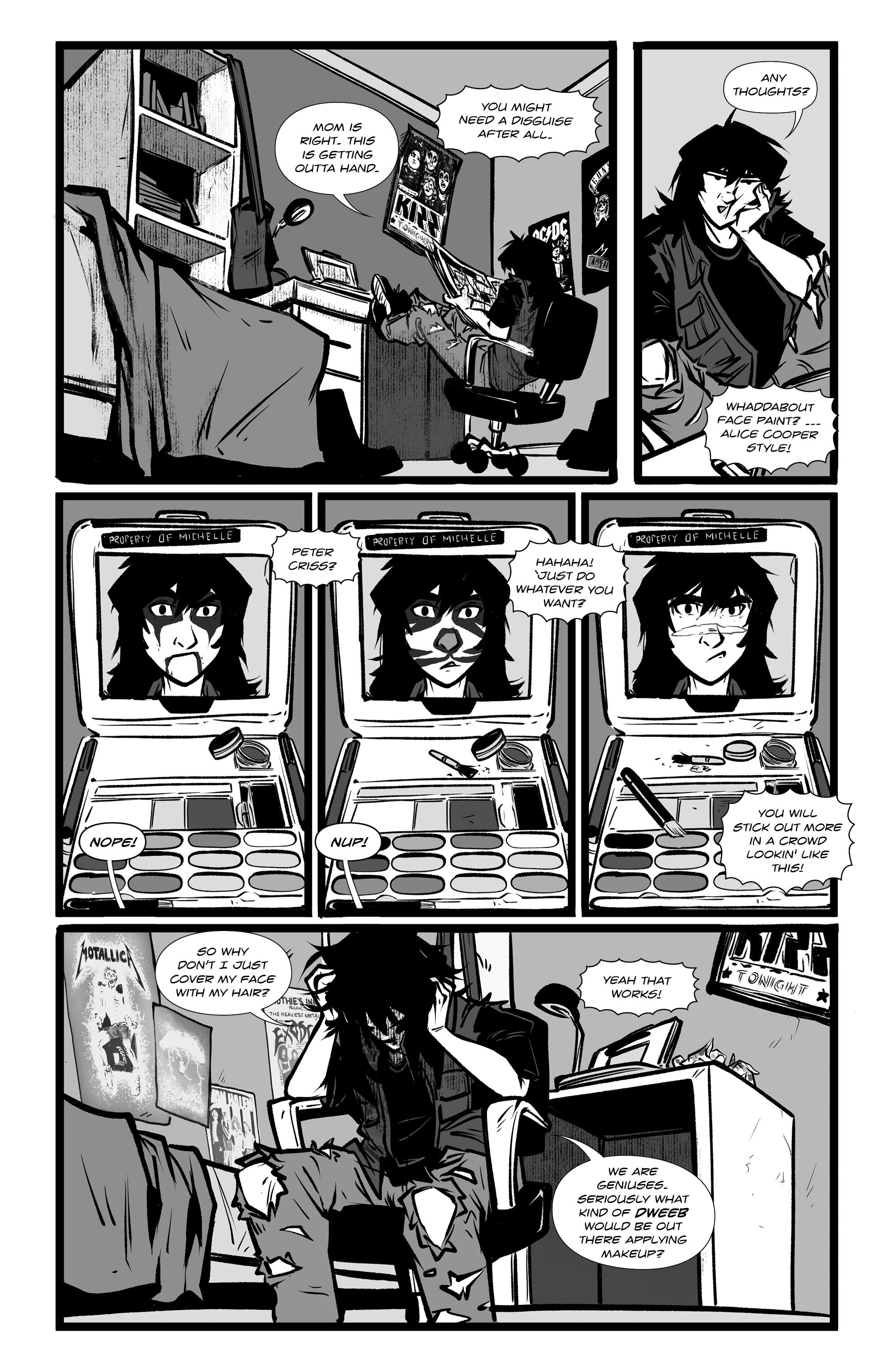 Lauren Marshall's linework on issue five: Maurice auditions a disguise, running through Peter Criss and Alice Cooper before settling on his own hair.
People have told me they've got their favorites among the three, but nobody's really had anything bad to say about the change once they understand it. I think readers get that this is how indie comics goes sometimes.
Do you run the story by anyone before it's finished?
My wife is a teacher — she teaches maths and English to grade six kids, so she's a cross-the-Ts-and-dot-the-Is kind of editor. I'll play with ideas with friends and family too. But generally I think I'm pretty good at cutting the fat myself. If something's only going to be in the story because it satisfies me, I probably won't put it in. If it satisfies the character and the progression of the story, it goes in. I've got a really good, close group of supportive, creative people around me. But at the end of the day, when I give someone advice, or take it, it's take it or leave it — I'm not going to feel hurt if you don't follow it, because it's still your choice.
The whole series has been black and white. Was that a deliberate choice?
Partly, I'll admit, it's about being cheap — pencils, inks, and color are three separate costs, on top of lettering. But I was also inspired by the Scott Pilgrim books: just go black and white, get the story out there, see what happens. Eventually I'll put out a collected volume and do a colored version then. It's become its own brand at this point, the black, white, and red — pretty recognizable at a Comic-Con, and it helps with the marketing. I've always loved that combination, and it comes from "Master of Puppets" too — if you look at the back page of issue one, I copied the exact layout of the album's photos. It's also meant to make the book feel like a zine, a DIY project, because that's what thrash metal was.
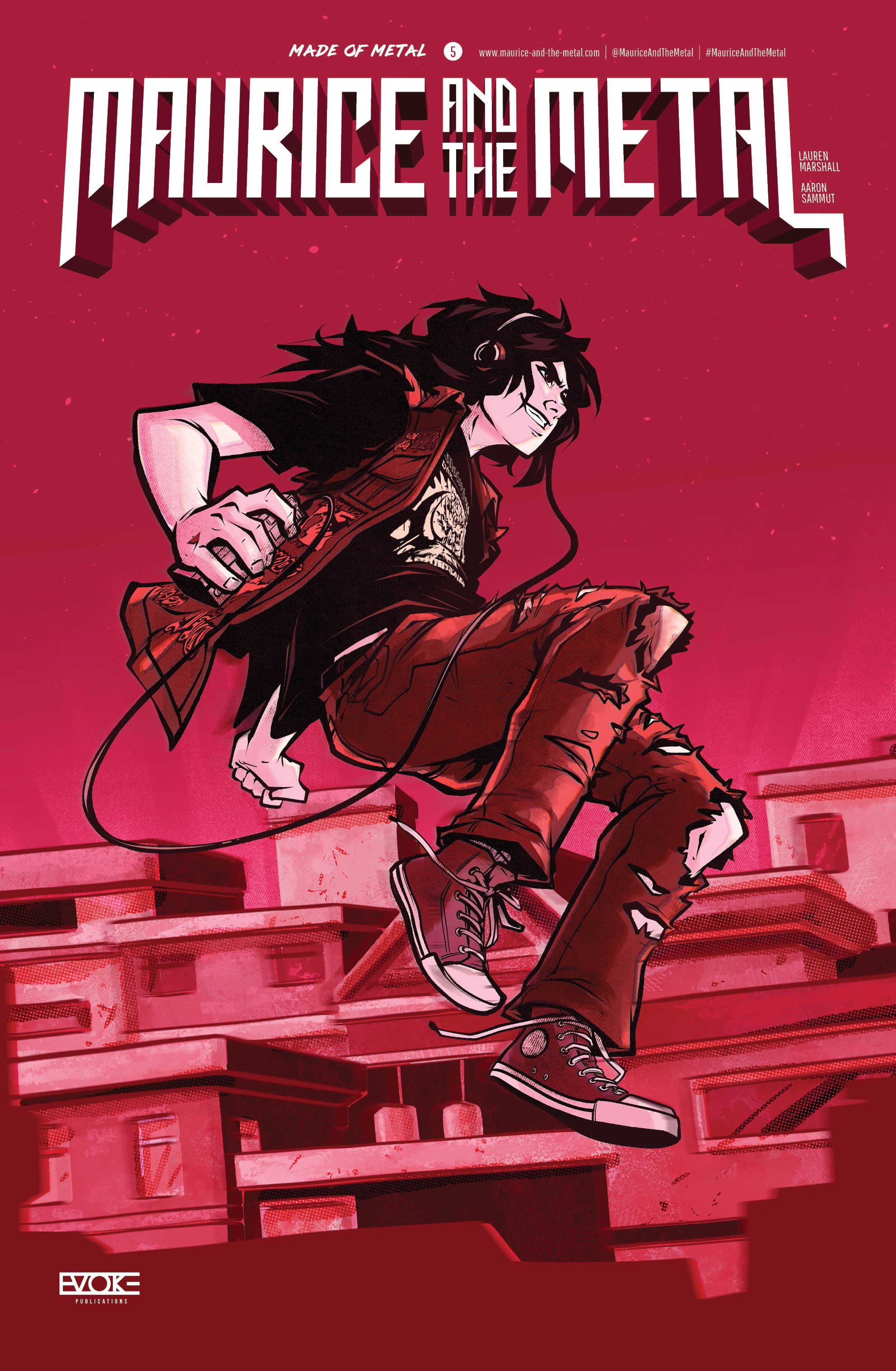 The issue five cover by Lauren Marshall — black, white and red.
The Walkman is possessed by Maurice's own father. How close is that to your own life?
I try not to give away too much of the plot — I think it's a pretty good sell point, even that detail on its own. But yes, it's close to my life. When I was growing up I wanted to be a superhero, obviously — I was an eight-year-old who loved the Hulk. In my twenties I wanted to be a drummer. In my thirties I went, you know what, I'm going to make a comic book about a superhero drummer instead. It's not a biography, but it's the impact music has had on me as a person. I don't know if I'd be the same person if music wasn't in my life.
I did have a Walkman, though not the one Maurice has — his is the original Sony. Mine was a cheap knockoff I had when I was about ten, and I was listening to Faith No More on it. That was enough.
Where did the idea for V and THE VAMPLIFIERS come from?
I wanted a villain from a completely different genre of music — someone whose goal is to make everyone conform, to push every genre in the Bay Area toward goth. Country goth, jazz goth, all of it, until metal is the only one left standing against it. I thought about grunge for a while, because it kind of softened the whole thrash metal movement, but that felt less interesting than someone with real ego issues. I was thinking about the Robert Smiths of the world — someone who wouldn't even see himself as the villain. I might have upset a few goth fans with that one. The name Vamplifiers was just too good to let go: a goth band whose sound makes people succumb to it, hypnotically. I love THE SMITHS and THE CURE myself — it's a genre that's musically undersold, and it does make you feel a certain way. The whole idea kind of wrote itself.
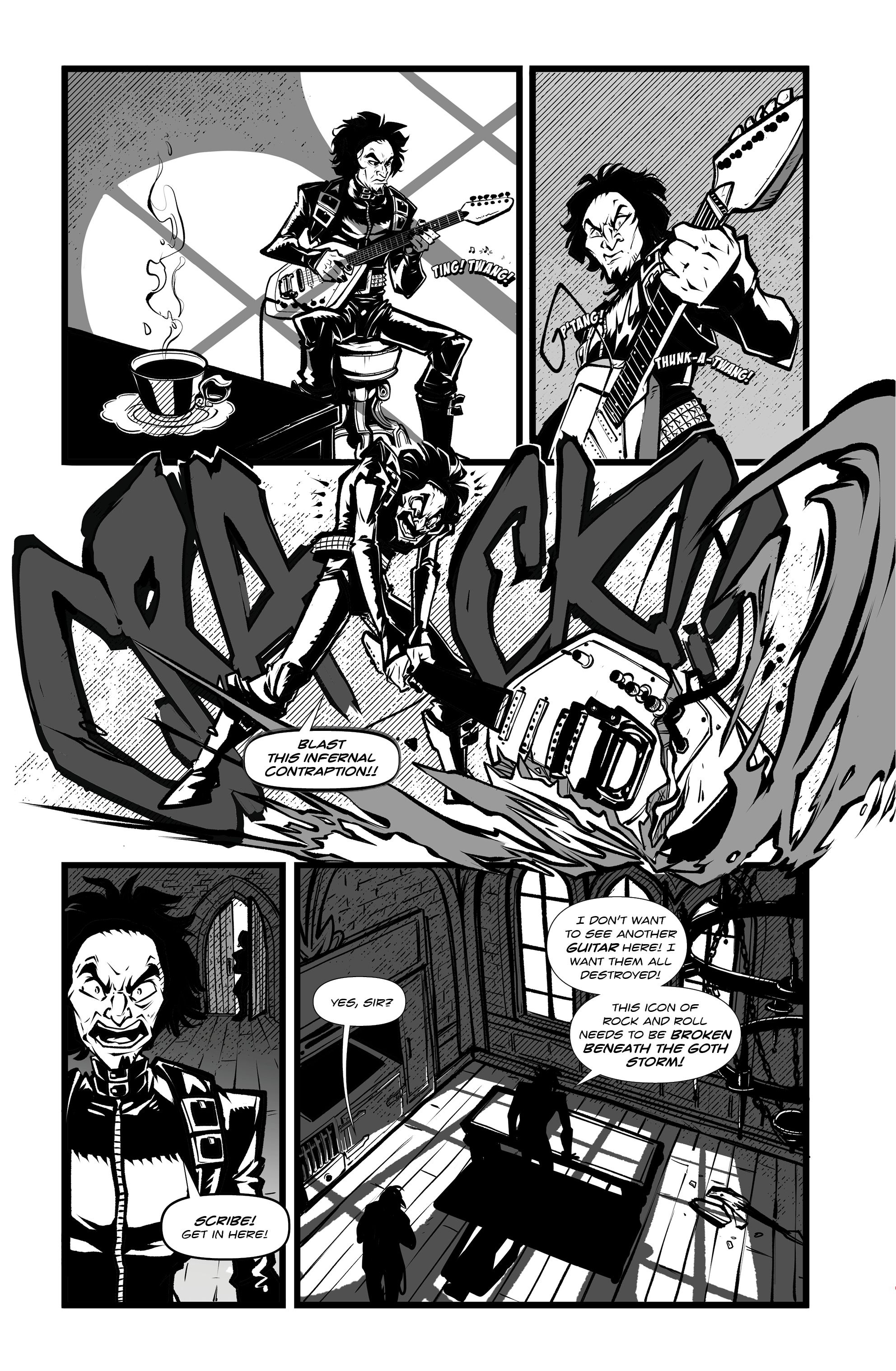 V, losing patience with the six-string: "This icon of rock and roll needs to be broken beneath the goth storm!"
So no hard feelings toward goths in general?
No, all the love to the goths — just not this particular one. If it hadn't been them, it would've been somebody else I'd need to apologize to. My goal was to make it a battle of the genres. When I was growing up, if you liked heavy metal, you couldn't like hip-hop. You couldn't like country music and metal, or country and hip-hop. It was based on the friends around you, the community around you, and you were terrified of the gatekeepers. Getting away from that is one of the things Maurice learns.
I also hope people come away from the book without thinking heavy metal was just some demonic pursuit. Thrash metal wasn't demonic. Possessed, maybe. SLAYER, maybe. But it was just a bunch of twenty-year-olds having a good time playing heavy music fast — it didn't need to be demonized. That's the satanic panic for you: looking for something to blame, and something loud and fast was the easy target. I've tried not to demonize Maurice as a character either, even when that stuff comes up around him. It's a great genre of music, and I think it's more widely appreciated now than it was. Back then it would've just been a loud racket to most people, but if I played "Fade to Black" for my parents, they'd go, is this METALLICA? I never knew they sounded like this. BLACK SABBATH's the same — "Planet Caravan" isn't metal, it's a crazy hippie song. "Changes" too. There's real depth in it. It's not just a surface genre.
AI is a live argument in every creative industry right now. Where do you land on it?
I'd put the line at the admin side. If I've got a problem with the code on my website, sure, AI helps me find a needle in a haystack. But on the creative side, I want the warts and all — I don't want something so glossy it looks like it was made by a robot. I've used it to help write an email for my day job, or as a sounding board when I've got an idea and no one's around, or for research — I was writing a Viking story once and couldn't settle on a setting, so AI was just a faster way to search Google. But when it comes to actually writing the script, pen to paper, AI doesn't touch it.
There's also a question of ownership that bothers me. I saw a comic strip once where someone in a restaurant asks the waiter for a pizza, the waiter brings it, and the person says, "look what I created." It's not the same thing. I saw a post on Facebook where someone had done this motivational quote over an AI picture of themselves, feeling pretty high on it, and they clearly hadn't checked it very well because they had four legs in the photo. Every comment was just "why do you have four legs?" Nobody was even reading the message anymore, they were just judging the image. I think that's going to become more common, and people are going to get more discerning because of it.
In my day job as a graphic designer, I'm losing work to the robots too, same as illustrators are. I studied photography at university and was still shooting on film — within a year it went almost entirely digital, and I remember thinking, well, I've put in the hard yards, now I don't have to be in the dark room anymore. Ten years into graphic design, same thing: I'd be etching the hundredth vehicle out of a photo by hand, and suddenly I could do it in Photoshop with one click. I've put in my hard yards, so I don't mind AI taking the boring parts of that off my plate. But I think people are going to come around to realizing AI art looks like slop, and treat it accordingly.
What about AI in music, since that's the whole premise of the book?
I can't imagine somebody who loves their genre of music that much wanting to take it easy. If you're playing guitar in a band and you want AI to fill in the gaps for you, I can't picture that — it's not like etching a photo or knocking out an Instagram card, it's fun, even after you've done it a million times. And honestly, if that snare sounds exactly the same on every hit, I glaze over. Hearing it land a little differently each time, that's the human part. AI's kind of made me appreciate that the mistakes are the good thing.
I think it'll actually make people more discerning about their taste. If AI starts putting out pop punk songs that sound like what a human band's already doing, that band's going to have to try harder — go somewhere completely off the radar. A bit of pressure makes diamonds.
Issue one came out the year before the pandemic. How did that stretch affect the book?
It was actually a really productive time. Working from home gave both me and the illustrator a bit more time — I learned motion graphics and some basic animation for the Kickstarter videos, and started other stories I've been pursuing outside of Maurice. It got a bit isolating personally, but creatively I didn't feel the slump, which was great.
Where's production at, and is November still realistic?
We've done about twenty of the book's forty-two pages, and there's a variant cover being drafted right now. Once the pages fall into place it's a pretty smooth process — the scripts are already written, the sketch version of the whole book is already put together, so from here it's mostly lettering. November's a very doable deadline.
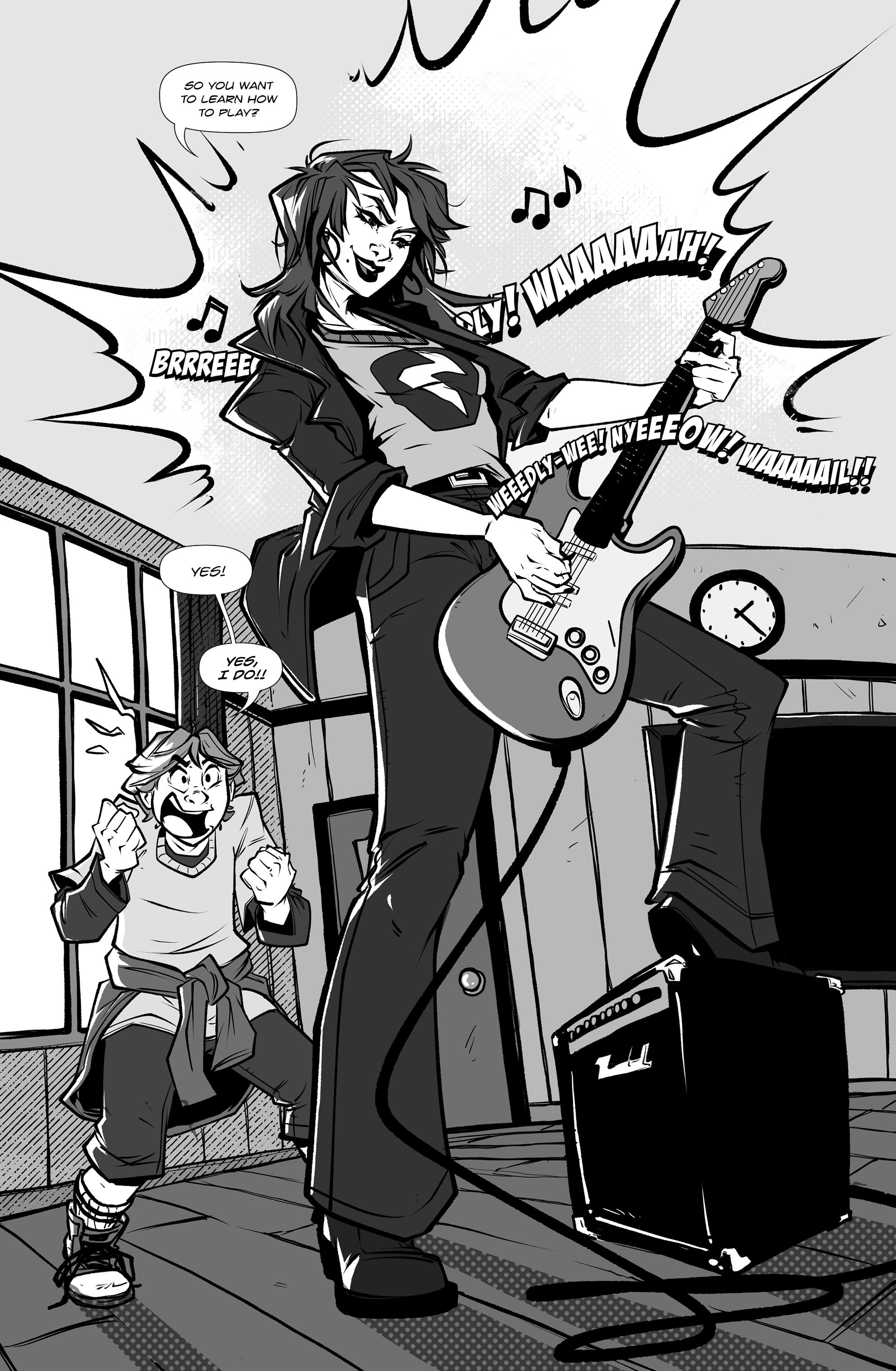 One of the twenty-odd finished pages out of forty-two — an amp, a borrowed guitar and a first lesson.
What's the actual goal for this campaign, beyond the funding?
Kickstarter's more of a platform for finding new readers for me than just financial support. My real goal is 200 backers — even if someone's just giving issue one a go, even as a PDF, I'm happy with that. I think the audience for this book should be bigger than it is, and that's on me being a bad business person, bad at marketing. You have to keep the algorithm happy, post something every five minutes, and I just don't have time for that. If I could get an AI agent to handle it for me, honestly, perfect.
What's it like meeting readers at Comic-Con?
I've practiced the pitch quite a bit at this point. Someone comes up and asks what the book's about, and I tell them: it's about a young slacker drummer kid who discovers he gets superhuman strength when he listens to heavy metal, and his Walkman is possessed by a Black Sabbath roadie. You can see it land — even people who aren't into heavy metal get why a character powered by music is an idea. If I get a laugh out of it, I know I've probably got a sale. Selling even one comic to one person is satisfying.
The first time I did a con, by the end of the day I realized that was the most speaking I'd ever done — I'd never had that many conversations with that many people. I was spent, physically and mentally, but so fired up by the people I was connecting with. The age range is wild. Metalheads in their fifties who grew up on IRON MAIDEN, then PIERCE THE VEIL fans coming up saying they'd want that power too. I think metalheads are just that kind of close-knit community. At the last con I went to, I met a ten-year-old who went through every book on my table and correctly called out that 'Disposable Hero' was a METALLICA song, and pointed out the SLAYER and ANTHRAX references too. Her parents were right behind her, and I told them, congratulations on raising this kid right. That's what makes it worth it more than the money — the conversations.
Do you see Maurice going beyond the comic — animation, games?
I'd love to see an animated version, maybe even a film, an ongoing series. There's enough story in the world of Maurice for a lot more issues and episodes. At one point I did get some interest from producers — we had about fifteen pitch meetings with studios, and sadly we didn't find the right fit on either side. But I'd love to get the story out there in that form eventually. Part of that is just growing the network, connecting with people like yourself. I see it going far beyond the comics.
The villain's whole plan is forcing every genre to flatten into sameness. But real genre-blending, blackgaze mixing black metal and shoegaze, is having a real moment right now. Does that complicate things?
I don't know why it works, honestly. When I first started listening to metal, it felt like a world opening up, and you feel a bit terrified — like, why do I like this, I don't understand what's going on. The first time I heard DEAFHEAVEN I had that same feeling. This shouldn't work, I thought, this is making me uncomfortable. By the end of the first album I listened to, Sunbather, I was hooked, because it was so new.
If someone picks up issue five cold, what's the one thing you want them to walk away with?
I've tried to write it so each issue makes you want to know what happens next — ending on a cliffhanger, and not making it all about the fights. I've been told the book is unique in that it's not just tights and fights. The Bay Area was an interesting place, even as a small local scene, and the stakes are high even there. What V and THE VAMPLIFIERS are pushing is genuinely dangerous. Maurice also goes on his first date in this issue — I tell people this is the story that John Hughes and Ozzy Osbourne would have written together. There's room in heavy metal for something that isn't cheesy romance, just a relationship. So, a warm feeling about community. The metal community, specifically.
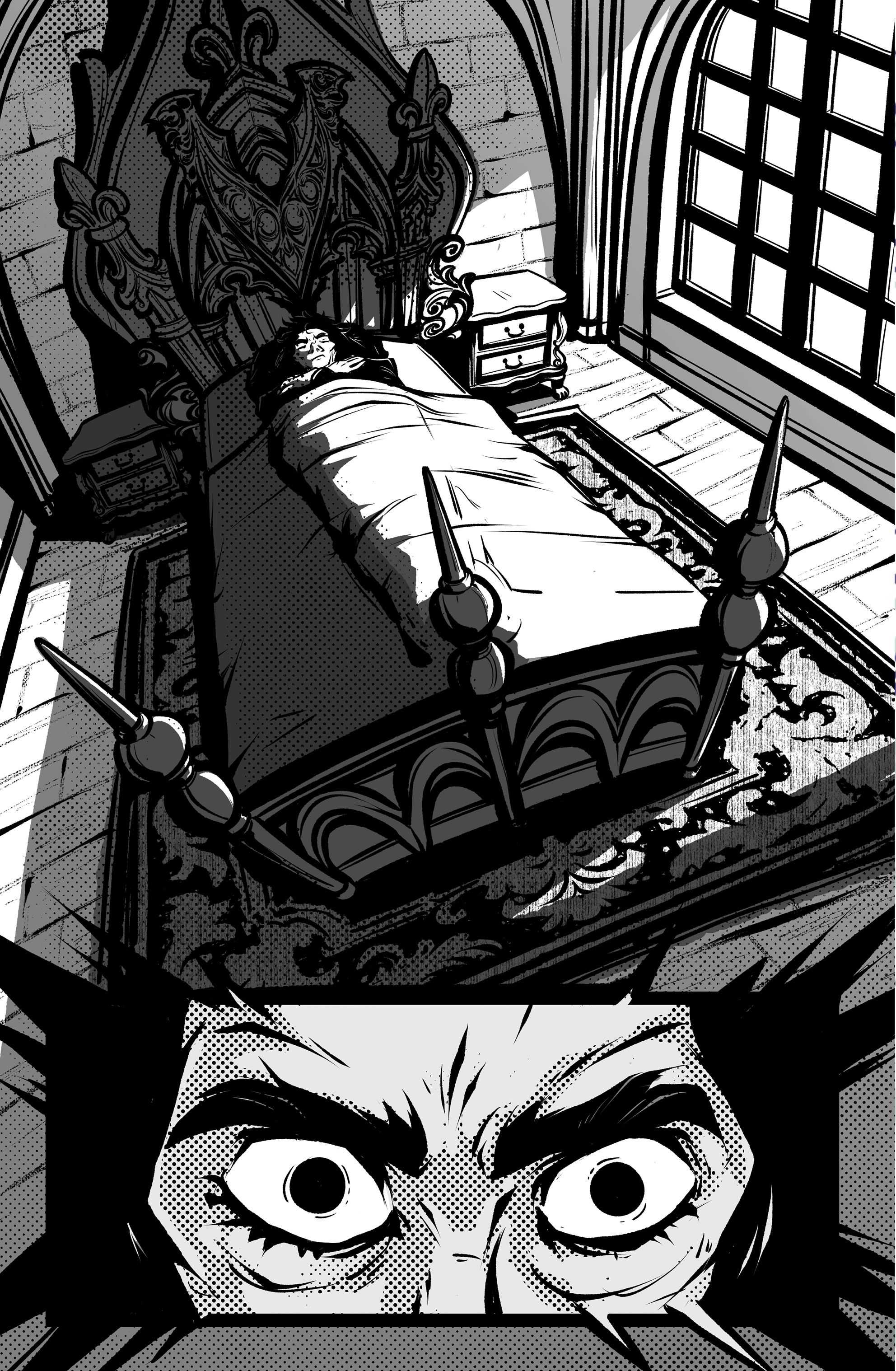 Not just tights and fights: halftone shadows and hard blacks, the house style since issue one.
Maurice & The Metal Issue #5 is live on Kickstarter now, with backer copies shipping November 2026. Thanks to Aaron Sammut for his time, and to Anthony Pollock at Soda and Telepaths for organizing this interview.