
Scorpio: Today's interview is a little unusual. It's not with musicians, but with the people behind the Slava Ukraine metal fundraiser in Scotland. Please introduce yourselves.
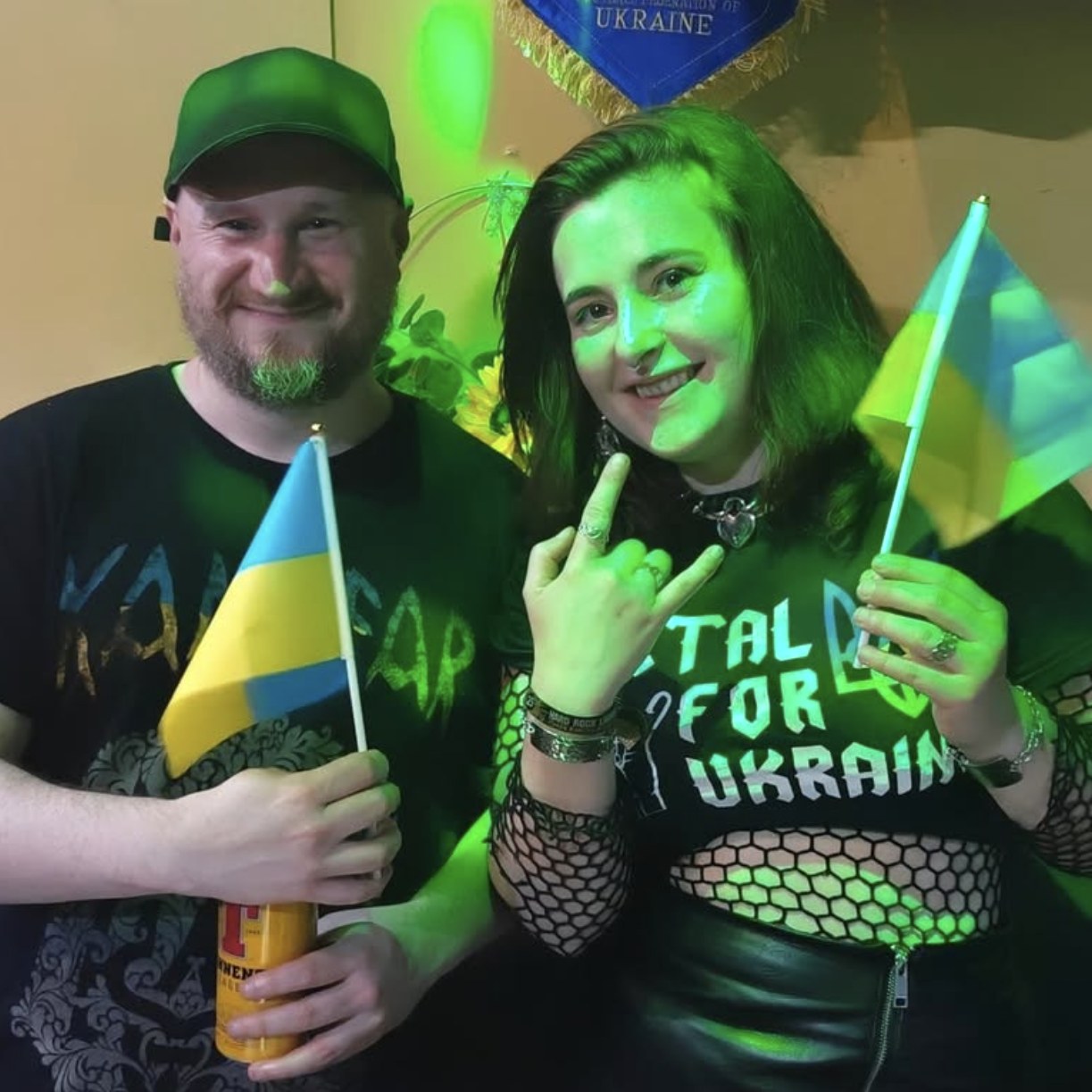
Alina: Hello, I'm Alina. Joe and I started this fundraiser in 2022.
Joe: Hello, I'm Joe. I'm the Scottish one. I started the fundraiser with Alina in 2022, and we've been doing shows ever since.
Alina: And markets now.
Joe, you're Scottish, not Ukrainian. What led you to support Ukraine and start these events?
Joe: I manage SAOR, and we played in Kharkiv in 2019. I basically fell in love with the country then. I'd always loved Ukrainian metal bands anyway — DRUDKH, NOKTURNAL MORTUM, 1914 — all those bands from my early twenties. So when SAOR played Metal East, the promoter, Dmytro, personally invited me to come along, which I was quite honoured by, because there was no real need for me to go. He was like, "We'd love for you to come," and I said, "Cool, I'll go." I really enjoyed it. I actually met somebody there, and we started dating.
Then in 2022, when russia launched the full-scale invasion, I wanted to do something to fundraise for Ukraine. The country was special to me because of the music I like, and because I was dating somebody from Ukraine at the time. And I remembered thinking, "There's a really cool guitar player who lives in Edinburgh, who I'm sure is Ukrainian. Let me find her on social media and see if we can do some shows together." I've got a lot of experience running concerts in Glasgow — fifteen-odd years of touring bands and all sorts — so I thought, why don't we do that? That would be pretty cool.
Alina, I don't need to ask about your connection to Ukraine, because you're from Kharkiv. But what brought you to Scotland?
Alina: Yes, I'm from Kharkiv, but I left with my mum — she moved to Italy first. That's where I fell in love with metal. There was a metal club in another city that I'd always go to, and I started playing guitar and doing my own bands. Then the music scene, and the university I got into, brought me here to Edinburgh — Napier University, on their music course. I just loved Edinburgh and the metal scene here, and then I met friends and everything.
Does Slava Ukraine only do metal gigs, or are there other events as well?
Alina: It was supposed to be a one-off. I thought it would last a few weeks, then a few months, then a year. Oh my God, that was a crazy thought. I was like, "We are not going to survive this." Now it's almost five years, so we're trying to find other ways to fundraise, with ideas from us and from the Ukrainian community here, and collaborations with other organisations. Mostly, we now do markets with merch. We've accumulated so much over the years, and we just brought more back from Lviv. 50% of our funds come from merch, so why not take it elsewhere too? Putting on gigs is huge work, so we do a bit of both.
How many events have you done so far?
Alina: Around ten.
Joe: We try to do at least one a year, around February, mainly to remind people what's going on — in the last couple of years it's not been in the news as much, and people have lost interest a little. Every time, the metal community comes out and supports us, and they love our merchandise because it's so unique: our own T-shirts, things handmade in Ukraine that you can't get here, honey, candy and—
Alina: That's new. We'll see if it works.
Joe: One of my friends in Kyiv used to make shot glasses out of bullets — I think they were from Bakhmut. At one of our shows they all sold out. So we realised these niche items are what people like.
We've mainly done metal concerts, but we need to branch out a little. Alina was part of a bakery sale, for example, where we raised quite a lot just from baked goods. On Saturday we're going to London, where NOAPOLOGY from Kyiv are playing, to do a stall. We also go to demonstrations on Saturdays in Edinburgh. But we don't stray far from metal, because that's what we know — Alina has played in metal bands, and I've run so many concerts. I was originally supposed to run shows for WHITE WARD and 1914, which were cancelled, but we always wanted to bring that back. And now we're finally doing 1914 in Glasgow.
Alina: And I see your T-shirt as well — on theme.
Yes, I'm wearing the 1914 shirt, and that's not an accident. When we relaunched the website and started the YouTube channel this year, 1914 was our first interview, and Andy Marshall of SAOR — whom Joe manages — was the second. So there's quite a connection. You're bringing 1914 to Scotland for the first time, and this tour is the band's first time in the UK. How did that happen? And you just met Dmytro, their vocalist, in Ukraine.
Joe: I'll start, and Alina can finish. I was supposed to do a show for 1914 way back — 2023, maybe?
Alina: Yeah. And I was supposed to play support at the time. I was like, "Oh my God," very exciting times. But it got cancelled.
Joe: Unfortunately. But we kept in touch with the band and the agency. Then we realised they were potentially coming to the UK — trying to make their UK debut, since the last one got cancelled. So we reached out to their agency and started talking, and when we met Dmytro in Lviv, we got the ball rolling a bit more.
Alina: Meeting in person is always better than all the chains of emails — their agents at Napalm obviously get lots of emails. It was great meeting Dmytro, and he seems very excited to come to Scotland. He loves whisky and everything, so our rider will have to live up to his expectations and knowledge.
I've heard he's not a big fan of beer, so I guess Tennent's — and even something better, like Vault City — is off the table.
Joe: No, no. We'll get him some really good whisky. He'll definitely enjoy that.
Alina: Lately Joe and I have been trying whisky, because we've just been to Ukraine — I went to see my family in the east — so we picked out some good whiskies. Hopefully Dmytro will appreciate them.
Joe: And we can show him Glasgow—
Alina: Edinburgh.
Joe: —Edinburgh. We can get him a haggis supper.
Alina: Some fried Mars bar.
Joe: Oh yeah, deep-fried Mars bar.
And Irn-Bru to wash it down.
Alina: I was going to say that!
Are you behind any other UK dates, or just the one in Glasgow?
Alina: We're co-organising the ones in Plymouth and Leeds. We got hold of them, we're getting a share of the ticket sales, and hopefully we'll manage to sell some merch there as well.
Joe: Because of my work with SAOR, I've got a lot of contacts on the UK metal scene — promoters, venues and so on. So I reached out and managed to get two shows included. Since we do this purely to support Ukraine, that helps us put some funds towards our fundraiser, and hopefully sell some merchandise. And at the Glasgow show, basically all the profit goes to Ukraine. Whether that's sending funds to people we know or to Dmytro and his guys, we're fundraising for Ukraine regardless.
How do you usually pick where the funds go? Are these causes where you know the people personally?
Alina: Mostly, yes. There's On Guard UA in Ukraine. There's also Ukrainian Victory Campaign here, whom we know personally — we do the demos with them, and we fundraise during the demos too: we sell bakery and raise awareness. So we know these people and we see all the reports. Also Musicians Defend Ukraine. We try to pick small fundraisers that we know, that are connected to us and are easily accountable.
Joe: Anytime DRUDKH do merchandise — basically anything Roman sells — the money goes to On Guard UA, and they distribute it. They always send photos and reports, so we know where the funds went. People are keen to know, because they're the ones buying the merch and tickets. And On Guard UA are part of the Ukrainian metal scene anyway, so it makes sense.
As Alina said, we also fundraise with Ukrainian Victory Campaign in Edinburgh, who we go to demonstrations with. The guy who runs it, Marian, has his own contacts. He'll send Starlinks to people, or if someone is driving to Ukraine with a car that's going to the front line, we'll send along things we've already bought, to give to the guys who need them.
Alina: There's also Edinburgh Spiders, who weave camouflage nets for Ukraine here — I've fundraised with them a bit too. It's great to come together and help each other in all this. For our last bakery event, I did the bakery with the Spiders — homemade by Ukrainian ladies here — and they brought cakes to our event as well. We do all sorts of things at our gigs: bakery, candy, and at the next one there'll be armoured combat, with proper steel armour, from people we met at the demos. Their armour is made in Ukraine. I didn't know much about the armoured combat world, but they told me the best steel comes from Ukraine. So there you go — Ukraine is connected to a lot of people in various ways.
We've done things like that since our first event. I was like, "Why don't we do a raffle? Why don't we have LED spinners?" And I think Joe was a bit like, "What?"
Joe: I wasn't sure LED spinning would attract metal fans, but it's a good change of pace, and everyone really enjoyed it. And the raffle is a fantastic idea — bands give us merch, we bring things from Ukraine, and people always donate a bit more than we ask per ticket.
Joe, you mentioned you'll be at the NOAPOLOGY gig in London. What's expanding your territory beyond Scotland?
We figured we want to try and expand a bit. Alina has been to festivals in Scotland and also in Estonia.
Alina: This year we started developing the idea of market stalls, so we messaged Wildfire Festival. It was an experiment, and it worked out great. At our own gigs, people already know what the night is about. I wasn't sure how it would work at a festival where people are just there for the festival, but it worked really well. The metal scene is very supportive — sometimes people just don't get reminded of what's happening, or don't know how to help. We also had a very good friend, Elena, doing henna tattoos and face painting. As you can see, we're becoming an events thing, not only about music.
Then I went to Estonia to work with Leopold of Metal for Ukraine. He's been fundraising at tons of festivals all over Europe — the north, the east, Germany, a lot of Poland, Lithuania. I helped him in Estonia and will try to help next year too. It's been great to learn from him how he survives festivals with all that merch, all that responsibility and all those volunteers. So we're expanding as much as we can, to help as much as we can, because I guess overall support is plummeting.
We also try to show a bit of Ukrainian culture — sometimes I put up poems by Ukrainian poets on the walls. And we have an amazing group of volunteers: Scottish, Ukrainian, Spanish. At the last event, a friend of mine from Kazakhstan and Ukraine came for the first time to help with the merch. At the end of the night she said, "Wow, it's amazing how many people of different backgrounds were brought together." She's not into metal normally, and her mum had been worried about the mosh pit, but she loved it.
How has the Scottish metal scene — the bands — responded over the years? I've seen some bands repost your Instagram stories that aren't about music at all, but about what's happening in Ukraine.
Alina: Honestly, the bands have been as supportive as the crowd. They've done Ukrainian-themed merch, they donate merch for the raffle, they donate in general — even other promoters, like our very good friend Duncan from Red Crust Promotions. At our last event in July, ALTERNATE FUTURE made a blue-and-yellow design for their T-shirts, and it's not the first time that's happened. For our next event in November, two of the bands on the line-up actually asked us if they could play. It's a huge honour. That's why we keep going. If the crowd wasn't so supportive, maybe at some point we'd have stopped. But people are driving us.
Joe: I'd say we're probably the only ones still consistently doing metal concerts for Ukraine in the UK. Between 2022 and maybe the end of 2023, there were regular fundraiser shows all around the UK. Then it started to die off, and I feel we're the only ones who've kept it going, kept it in the spotlight, and actively brought Ukrainian bands over — not just because we're promoters, but to introduce those bands to a UK audience and remind people how important it is to help Ukraine. I'm quite proud of that, because we're representing Scotland and supporting Ukraine at the same time.
Now bands are asking us to play, which is good, because usually we'd do the talent scouting ourselves. One of them has members from Lithuania, so there's a nice connection — they understand what it is to live under russian rule. And we've got a really good line-up: CNOC AN TURSA are playing in November. They're a Scottish folk metal band with members who used to be in SAOR, and it's their comeback show in Glasgow after playing all over the UK this year, so we're looking forward to celebrating that at our Ukrainian fundraiser.
Why does it matter for Scotland, and the UK in general, to support Ukraine?
Alina: I think people can see themselves in Ukraine's values — democracy, independence, the fight against tyranny. Not only on the metal scene: at the camouflage netting or at the demonstrations, I see lots of Scottish people, even Americans, and I'm always shocked. I even tell my family, "People are learning Ukrainian here." Maybe Joe can tell you more about why, but I'm honestly very honoured — it's just very heartwarming. People in England as well. I feel we definitely have a connection: love for metal, and love for our own nation and culture.
Joe: That's it — the culture, fighting tyranny, being independent. Maybe I'm a bit different, because I've always been into Ukrainian metal and Ukraine in general. But when we went to Lviv, people were obsessed with Scotland. We met a guy who spoke to me in a Scottish accent. I was like, "Are you taking the piss out of me or something?" But he just absolutely loves Scotland. I don't think you get that love affair with England.
And to bring it back to Kharkiv in 2019: lots of people came up to us saying they felt a connection with SAOR's music, with it being about Scotland, and that there's a connection between Scotland and Ukraine. They were very happy to have Scottish people performing in Ukraine. There's a sort of brotherhood, a brotherly love, that people resonate with. We see that a lot at the demonstrations, and at the gigs as well.
Do you meet people at the demos who say, "It's not our war," or who are openly pro-russian?
Alina: Oh, yes.
Joe: All the time.
Alina: We even get russians. Though we also have russians volunteering with us, by the way — that's true too, and I personally really appreciate it. We get people of all nationalities. We get shouted at; sometimes there's real aggression in our faces. But the worst thing that happened — even though this person didn't shout at us — was a woman in a T-shirt with putin holding a gun and the words "From russia with love." I can send you the picture later, because you won't believe it. Marian asked me to take a picture, because she was probably taking pictures of us. We notice people photographing our faces, and we're mostly OK with that; some of us aren't and wear a face covering. But this woman was completely shameless, standing right in front of us — it was no coincidence. Unfortunately, these people are everywhere. I feel the UK is very supportive in general, but people don't realise these people are among us. At festivals I spoke with lots of people — that's another great thing about festivals — and they'd say, "But here, everyone supports Ukraine." And I'd say, "Let me show you this picture." They were shocked. Whether someone is russian or not, wherever they're from — that's supporting pure violence. It's not even about politics anymore.
Joe: We get russian propaganda talking points shouted at us quite frequently. Usually we just laugh it off, because we know it's ridiculous. But I always feel a bit sad for them — they've been so brainwashed by disinformation on the internet that they feel they have to go out of their way to shout at us that we shouldn't be supporting Ukraine. So we always try to keep our cool and just laugh it off.
Alina: Marian organises the demos, and at the end of the day we're representing an organisation. If it were just me, I'd maybe reply with a few more words. But we want to be professional — we're representing Ukraine. We're also being trained in the right responses and the right facts, because you don't want to reply with the same aggressive language. It's about educating people: "Google this. Look at the overall picture. If you want to tell me your opinion about my country, then please educate yourself" — and not from something you read on Facebook. Sometimes people actually start to wonder, and I hope that, if they don't change their minds, they'll at least become wary of propaganda.
But it's not all doom and gloom. We're at the demos to fundraise, and lots of people donate, come to support us, even join the protest and say words of support. The overwhelming majority of responses are positive. We have meetings where we write down what happened, and usually there are one or two bad experiences. At the last demo we organised, there were none at all. I think it's because of the visuals we had about Oleshky: plates on a dining table, filled with wild herbs and edible wild plants we'd gathered, to show what people in Oleshky have been eating. It was very striking, and maybe people thought twice before shouting at us.
Joe: We also get people from Hong Kong coming to the demonstrations — guys whose friends went to Ukraine, fought russia and, unfortunately, died. They come to show solidarity with Ukraine and Hong Kong, and some come to our concerts with their flag, too. But we don't get any hassle at the shows. You don't necessarily need to support Ukraine to enjoy the music, but we're always open about what we're doing and why. As Alina said, you can be neutral if you want — as long as we're transparent, there's no problem.

You both recently went to Ukraine. Joe, you were in Lviv, and Alina went all the way to her family in Kharkiv, very close to the russian border. What was most memorable for each of you?
Joe: Meeting people I've been speaking to online for months, sometimes years, for the first time. We met a volunteer from Scotland called Jess, who's with an NGO called Bravehearts for Ukraine and evacuates people from the front line. She's only 22, and she's been doing it since the full-scale invasion began. It was also really good to sample the food and drink of Lviv — it's a very culturally rich city, very different from Poland, and certainly very different from Scotland. And we met Dmytro and the 1914 guys the day we arrived; they were leaving for Poland that night. We'd been travelling since 6 a.m. — flights, multiple buses, hanging around at the border, a taxi to Lviv — but we said we must make it. It was good to finally sit down, have a few drinks and talk to Dmytro, whom I've been speaking to for years. It was my second time in Lviv, and my favourite.
Alina: I'm glad! For me, the most memorable thing was obviously seeing my family. I made it to my gran's 85th birthday in Dnipro — I called her the day before and said, "I'm coming over." It was a very emotional time. And seeing my family in Kharkiv as well. Last time I said I was coming, they said, "Don't. It's too dangerous." So I didn't. But unfortunately it's got to the point where I don't see it getting better in the coming months — it's only been getting worse over the past years. I was like, "I wish I'd gone last year, or two years ago." Now there are these jet-powered drones all the time, and there's no air defence either — I didn't hear it once in three weeks. I'm always following the news, and I know as much as I can from here. But it was amazing to see the spirit of our people — how resilient they are, and how they're managing to cope with all this.
Lviv was more like an introduction to the situation. It felt quite safe — we didn't have a single alert there. It's a kind of false security, but the situation is very different. In the east, you have to make peace with the fact that there are always alerts. In Dnipro it gets bad — there are Shaheds. In Kharkiv, you just switch it all off, live your life and accept fate: if it happens, it happens. But it's so important to still check the alerts and go indoors. When you're there, you're in a different reality where you think, "Oh, it's just an FPV drone. It's just a Shahed." I adapted surprisingly quickly — I was shocked by how calm I was, and my friends too. With a Shahed, you can see where it's moving. But sometimes it's KABs, sometimes missiles, sometimes planes, and it's the same alarm. You need to know when it's a KAB — that happened to me when I was there, and thank God I went indoors.
It's very powerful to see how resilient people are, but it's extremely heartbreaking. I can't imagine living like that for five years — what's been happening lately in Kharkiv and all over Ukraine is horrendous. But it was also amazing to be home. We'd have a barbecue — shashlyk outside — with the siren going, and I'd say, "Guys, maybe let's go indoors?" And they'd say, "Don't worry." OK, right. It was an amazing time, and I was very lucky to make it back, with the evacuation trains and everything.
Before we finish, let's do a quick-fire round. I'll name two things from the same category — one from Ukraine, one from Scotland — and you each pick one. Alina, you start. Zhyvchyk or Irn-Bru?
The old Zhyvchyk — without the new apple character on the label, which I really don't like.
Joe: I know what you're talking about.
Alina: I complained about this at the show.
Joe: Yeah, I remember.
Joe, how about you?
I don't think I've actually had it, to be honest — I've seen the photos. But regardless, I'd go Irn-Bru all day long. Specifically the Irn-Bru from when I was a kid, because they changed the sugar content.
Obolon or Tennent's?
Alina: Obolon.
Joe: Obolon.
Why not Tennent's, Joe?
I don't mind Tennent's — actually, I prefer Lvivske. Maybe Obolon just feels special because it's foreign to me, and people in Ukraine feel the same about Tennent's — I did see people drinking it there. But Obolon tastes better. Tennent's is like drinking juice: OK as a cold pint on a hot day, but if I had the choice, I'd go Obolon.
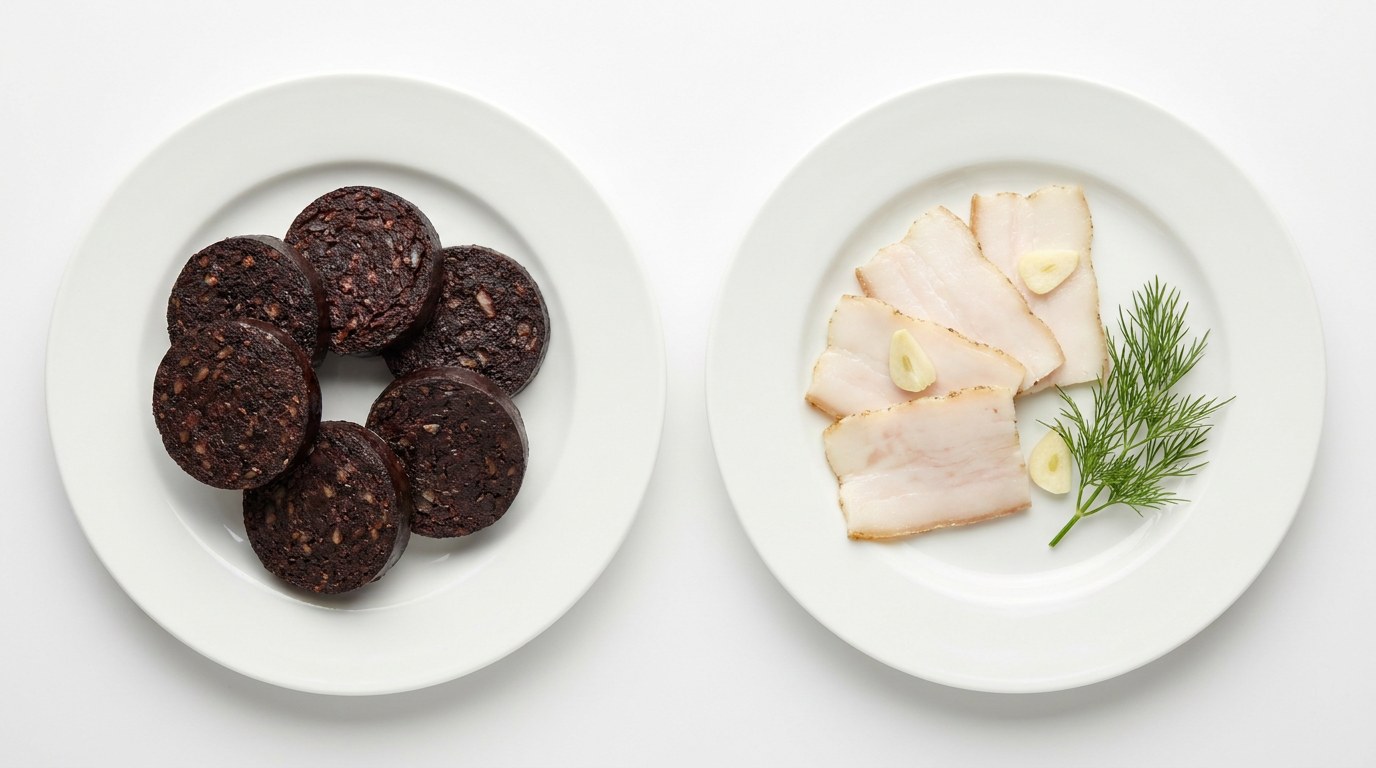
Salo or black pudding?
Alina: Salo.
Joe: Black pudding for me, all day. I like salo, but it's black pudding.
Alina: Why choose? I love both. In Ukraine we have blood sausages like that too — I've always liked them.
Joe: I think we do amazing black pudding, though.
Alina: It's great. And nobody fries things as much as Scottish people — it's all fried here. Oh, we actually had a Scotch egg in Lviv!
Joe: That's right, that was funny. They asked for feedback on how the Scotch egg was. It was tasty, but it just wasn't a Scotch egg.
Alina: It was too healthy. The beef was low-fat, it wasn't deep-fried, and I think there was dill on top — a Ukrainian touch. Too healthy for Joe.
Joe: Way too healthy. But they wanted the feedback because I'm Scottish, and I think they were happy to get it. Maybe when I go back, I'll see if they've implemented my advice.
Joe, have you ever been to the Whisky Corner restaurant in Kyiv?
No, but I wanted to — it was in my plans, but I never managed to go. I can't remember why, to be honest.
Alina: Days go so fast there. I had some admin to do for my documents, and there's just so much to see, so many beautiful things. Then you meet people and want to enjoy it — have a coffee, some Piana Vyshnia. We'll definitely be back. We made amazing friends there. Hopefully one day we can do a concert in Ukraine.
Joe: That would be good.
Alina: When the war is over — so many possibilities. We actually booked WHITE WARD once, and it didn't go ahead. After the war, hopefully we can do a lot of new things.
Joe: I get a lot of whisky here anyway, so it wasn't a must-see — though it looked really fancy. If I'm in Ukraine, I want to drink Piana Vyshnia, Nemiroff vodka, or just homemade alcohol.
That makes sense. I've been there once, in the winter of 2016 or 2017. It's a nice restaurant with a modern take on haggis — and the waiter recited Robert Burns' "Address to a Haggis" to me as he served it.
Joe: I remember seeing photos and thinking it would be quite an interesting place. But there's a bar in Kyiv called Docker-G Pub, which you probably know, that sells Tennent's. I remember speaking to the bartender, and he was shocked that somebody from Scotland was drinking Tennent's in Kyiv.
Vyshyvanka or kilt?
Alina: Well — both. They complement each other in such a great way. Especially now that there's a Scotland-Ukraine tartan.
I actually ordered a wool necktie from Scotland in the Ukrainian tartan.
Joe: It's a very good company — very good material — and they usually sell out because things are so well made. I really like the vyshyvanka, especially on women; it suits them very well. I like it on guys as well. But if I have to choose, I'm going to say kilt.
For the last one: "Shchedryk" or "Auld Lang Syne"?
Alina: "Shchedryk." It's the OG.
Joe: What's that one again?
Alina: "Carol of the Bells."
Joe: Oh, I'd say that. It gives me goosebumps for some reason — it's haunting. And I remember when people first realised it was Ukrainian. It was just another thing people are discovering about Ukraine that they didn't know before. So I agree with Alina.
Thank you very much for your time, and for everything you do for Ukraine. Now please tell our readers: when can they see 1914 in Glasgow, and who's supporting?
Alina: We haven't actually announced the support for Glasgow yet. Should we do it here, Joe?
Joe: I think we should give Volodymyr an exclusive.
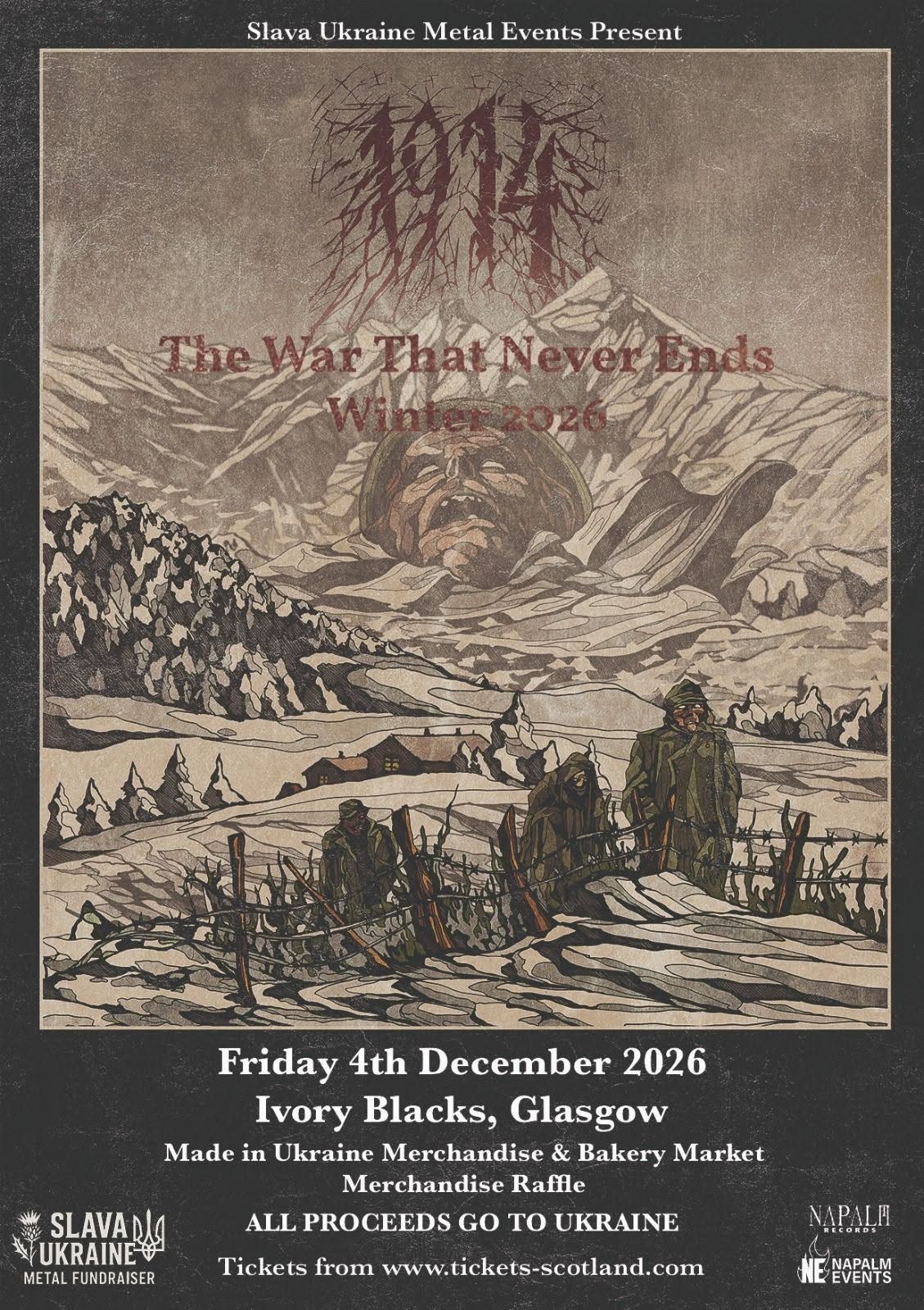
Alina: Exactly. It's Friday, 4 December, at Ivory Blacks in Glasgow. Support comes from RUADH.
Joe: RUADH are a Scottish folk black metal band. Very good band, and they complement 1914 well. They were actually supposed to tour the UK with 1914 in 2023, a whole tour that never materialised. So we figured, why not invite them to play?
Alina: We'll also have an event on 20 February, as we do our yearly fundraisers. And we're in talks about having our stall at more festivals in spring and summer, and collaborating more with Leopold. If anyone wants to help in any way, contact us — sometimes we need posters made or something. There's only so much Joe and I can do.
Joe: And if there are any Ukrainian bands who are able to leave the country and travel to the UK, we can help as much as we can. We want to bring more Ukrainian bands over — not necessarily metal, although that would be good — just to help spread the word about Ukrainian music in the UK, and in Scotland in particular.
Alina: And of course, local bands from the UK: please keep messaging us if you want to play. You make our jobs much easier. We know you care about the cause, and that's the best thing ever.
Thank you very much.
Alina: Thank you so much. Slava Ukraini!
Scorpio and Joe: Heroiam slava!
1914 + RUADH — Friday, 4 December 2026, Ivory Blacks, Glasgow. All proceeds go to Ukraine. Tickets
Next Slava Ukraine events: 21 November, Ivory Blacks, Glasgow (CNOC AN TURSA, CHEKHOV'S GUN, PICT, ARC ARRIVAL) — tickets; 20 February 2027, yearly fundraiser.
Support Slava Ukraine: PayPal | Card (SumUp) | Financial reports
Follow Slava Ukraine: Instagram | Facebook | YouTube | TikTok | All links
Also on The MetalList: 1914: Viribus Unitis — With United Forces | SAOR: Caledonian metal
Thanks to Joe and Alina of Slava Ukraine for their time, and for everything they do for Ukraine.