Scorpio: You recently released your new album. We're less than two weeks from the release date — what are you busy with right now?
Dave: Busy with everything album and tour related. We've got an Australian tour that starts next week, and of course we're doing as much promo as we can for the new album, on top of juggling work life, family life, everything else. It's a good problem to have, but finding the time for it all is the tricky part.
You've said before that you finish writing the songs in the studio. The typical process for a lot of bands, especially younger ones, is to have everything written and rehearsed before they ever go in to record. It's different with you — how does that process actually work?
It's definitely evolved over the years. In the early days we did it exactly like that: wrote the songs, rehearsed them — maybe too much — then went into the studio and recorded them pretty much as they were. But over the years, as Joe's engineering and production skills grew along with the band, we started experimenting more. Especially early on, you'd come out of the studio thinking, "Oh, I wish we'd done that instead." You're always watching the clock, and the ideas don't always come out the way you'd imagined them — you think it'll sound one way, and when you hear it back, it doesn't. So we leaned into the studio as a writing tool. When I track my drums, the song is still just a skeleton. That lets everything evolve as we go, and it's worked especially well on this record — the songs almost write themselves, and you only really hear what everything sounds like in hindsight, rather than rehearsing something to death and then refusing to change it in the studio because you've played the idea a million times already. Now it's more like, "Okay, let's try this. No, that didn't work — let's try that instead." It's a little flippant to call the studio a writing tool, but that's genuinely how we use it.
Are the lyrics written beforehand too, or also finished — even started from scratch — in the studio?
A bit of both. Our studio sessions are pretty drawn out because Joe owns the studio, so there's no time crunch — we don't book six weeks and knock the album out. We chip away at it. The only real block of solid recording is the initial drums, and that might be a week. Once that's done, it's the foundation everything else gets built on. The lyrics evolve right along with the song — sometimes a phrase doesn't sit right with certain words and needs tweaking. In the past, once something was written it was done and we didn't touch it again. I much prefer this more flexible way of writing and recording.
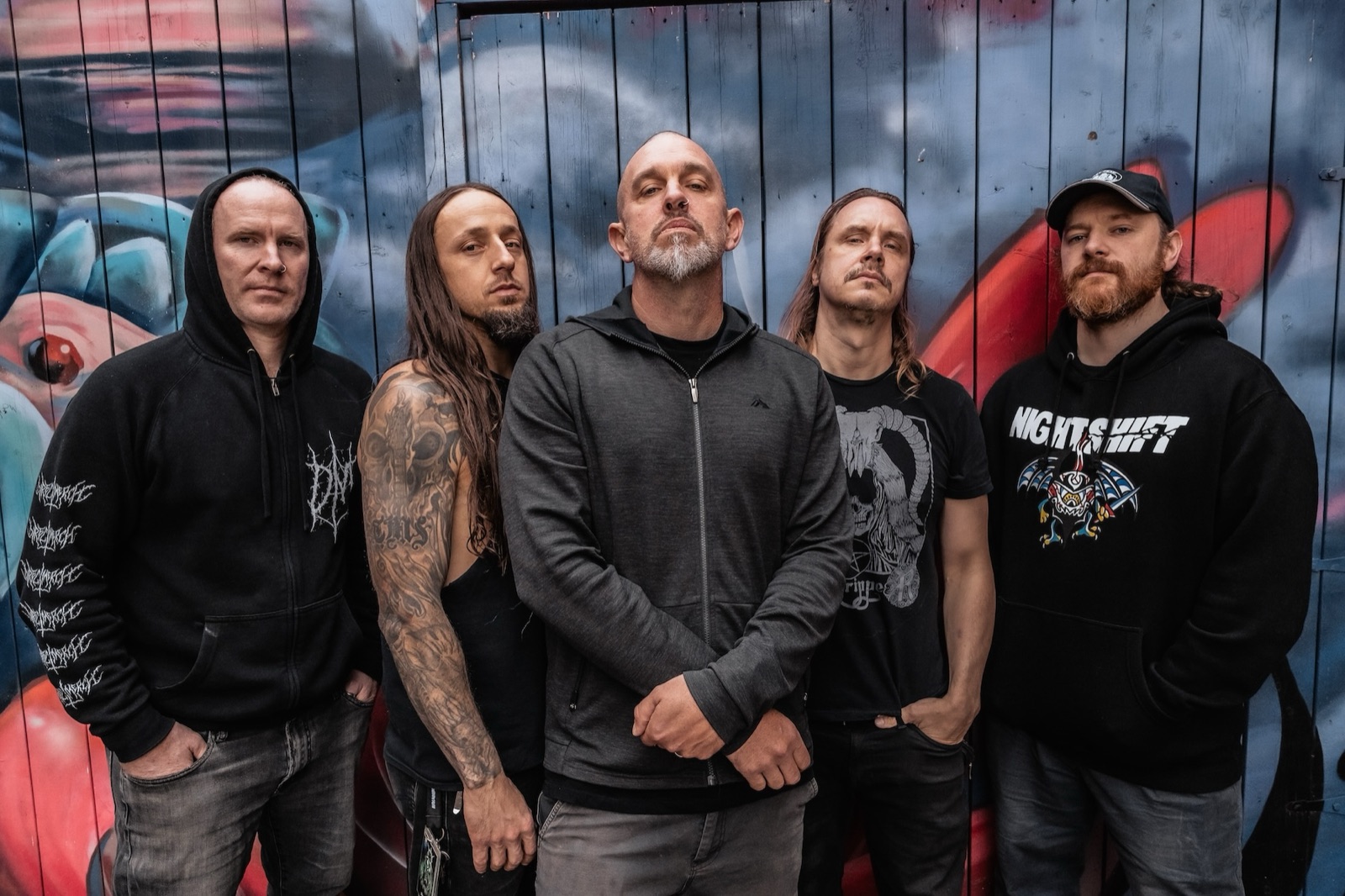
PSYCROPTIC. Photo by Rae Chatten.
I read that you re-recorded your drum parts for what I believe is the album's main single, "Gathering a Venomous Herd." What wasn't working?
I pushed that song to the very end of the studio schedule. Normally, Joe sends me a loose structure for a song — the skeleton — and I'll rehearse it for a few months, playing it differently every time and letting the ideas evolve, so by the time I get to the studio the part is almost fully formed. "Gathering" I put off until last, and nothing was coming together. I didn't like what I'd prepared, so it ended up being the last song we tracked, and it wasn't a fun session. In hindsight it came together really well, but I had to work through a lot of different ideas to get there. We worked hard on that one — it doesn't sound like it, it sounds like a pretty easy song, but there are a lot of syncopated parts in it, and because it's mid-paced, anything off is going to stand out. What I'd prepared wasn't right, so it was, "Alright, let's rewrite it, let's try something new." But we got there in the end.
That's great. I enjoyed two songs on the album with these dark, acoustic — almost oriental — melodies in the intros: "A Sword of Me" and "Our Pillars Fall." Where did that come from, and is that a direction you'd want to explore more?
We've dabbled with it on a lot of albums in the past. We let Joe have free rein over that last 10% — the cherry on top, which is all those acoustic bits. He's got such a wide-ranging musical palette that it pulls out ideas you wouldn't necessarily think fit into metal. That's what I find refreshing about this band: there's no real rulebook. We can do whatever we want, and it's as interesting for us as it is for the audience to hear the final product, because nobody really knows what it's going to be. One idea sparks another, that sparks another, and you end up with something like those acoustic intros — "Well, this needs something, what about this?" — and it reveals itself. So yeah, I'm never going to say never to anything with this band. I didn't know how this album was going to sound until I heard the finished product, and I remember thinking, "Cool, this is a bit different." It's more mid-paced, a bit more thrashy, and definitely more varied than some of our previous records.
I know in the past you guys pushed back on the strict "technical death metal" label. It sounds like you're still evolving away from it.
Yeah. It's just a tag — we're not ashamed of it or offended by it, but I don't think it suits us these days. Previous albums, for sure, were very, very technical. These days our song structures are a lot more traditional, even if the riffs are intricate — that's just Joe's writing style, and he doesn't think of it as technical, it's just how he writes. We're not trying to be technical for technicality's sake, we just do whatever the song needs. In the past we definitely fell into the trap of jamming too many ideas into one song; these days we let the music breathe. We do come out of the tech death scene historically, and I still listen to it here and there, but honestly, I'd rather put on Bolt Thrower than the latest crazy tech death release.
You produce everything yourselves. Did you ever consider bringing someone outside in for fresh ideas, or are you completely happy being self-sufficient?
We've talked about it over the years, and here and there we've had other people mix a record. It's worked pretty well so far — Joe writes the music and produces the albums, he's got his own studio, and we don't feel stale. I think we're still writing pretty fresh, unique music, so if it's not broken, we probably don't need anyone else right now. Maybe if we ever get stuck, I wouldn't rule it out. But everyone's genuinely happy with how we write and record at the moment. We work hard, but it stays relaxed, and we're still coming out with stuff that sounds uniquely PSYCROPTIC. If that ever starts to feel stale, maybe then — but not in the near future.
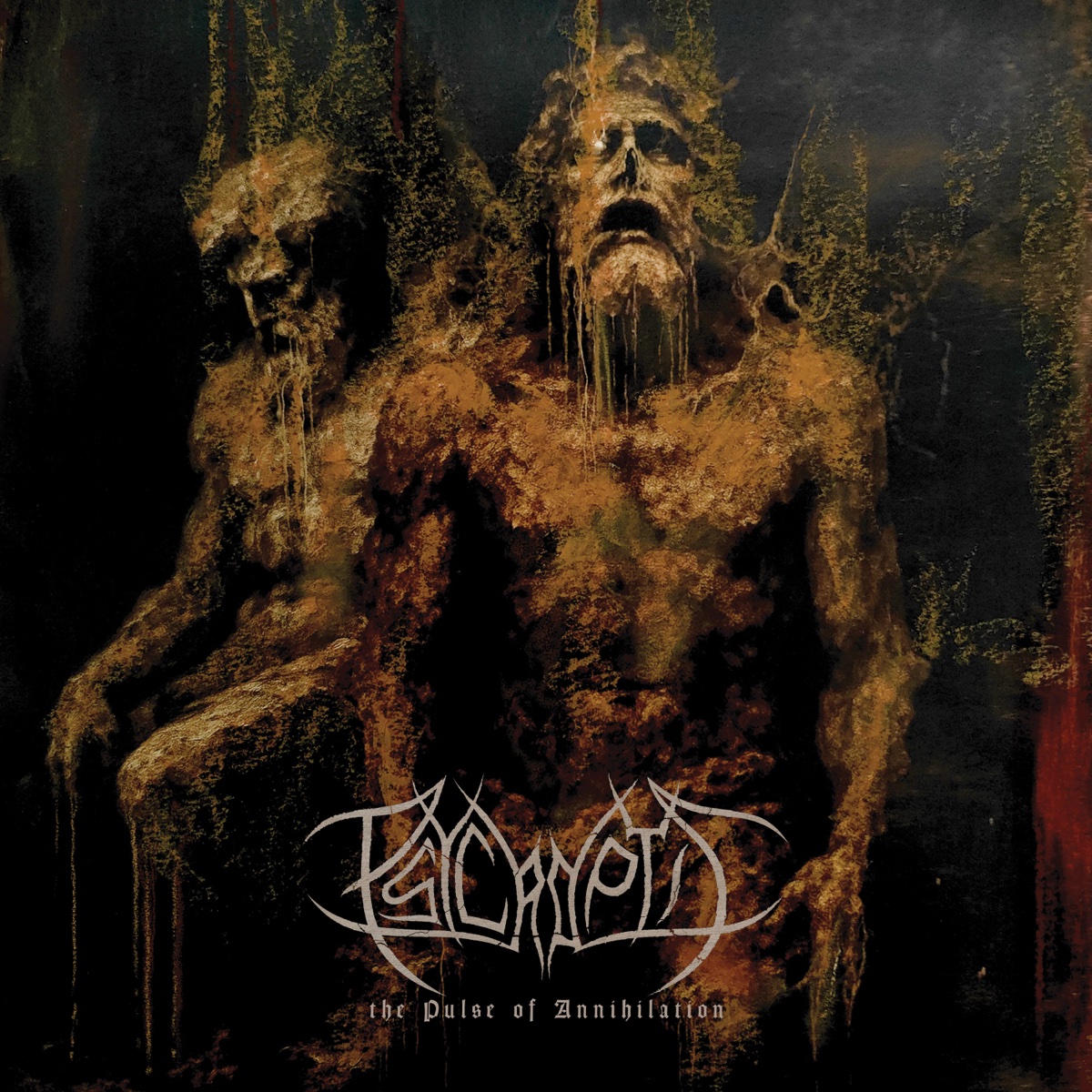
The Pulse of Annihilation — cover art by Belial Necroarts
Let's talk about the visual side — the cover. To me it reads as two ancient statues in a withered state, now covered in leaves and overgrowth. Am I close? And what story does the cover tell, versus the album itself?
With any artist we work with — visual art, film clips, whatever — if we choose to work with them, we give them, within reason, complete creative control. We hand over an idea and say, "Take this and run with it, let's see what you come back with." The artist here is a phenomenal Portuguese artist who goes by Belial Necroarts. The brief was loosely: what would an immortal, godlike being — however you want to categorize it — look like if it were immortal but didn't want to be? Within a week he came back with the cover, and it was, "This is perfect, no changes." We'd sent him some lyrics from the album so he could get a feel for what was going on, and he already knew our back catalog of artwork — we don't want to repeat ourselves, so we basically told him, "Here's what we've done before, now go your own way." The second we saw it, it was, "This is done, just add the logo." I think that's the secret to working with an artist: if you trust their ability, you give them free rein, and they'll take ownership of the idea and come back with something far better than if you hand them a list of guidelines and ask for three rounds of revisions. I don't think you get anyone's best work that way. It was a genuinely simple process.
When you work with someone like that, you've usually seen their portfolio and already trust they'll deliver — so you want to give a creative person that freedom, because otherwise they'll get frustrated and just tell you to find someone who'll follow instructions to the letter and not bother them.
Exactly. There have been times I've been asked to play session drums on an album, and they send me programmed drums and say, "Just play this." And I'm like, "You're going to need to find someone else, because I'm not interested." If you want me to be an artist, I'll be an artist — if you want me to replicate someone else's work, that's not for me. I think that mindset resonates with other creative people. The moment they can take ownership of an idea, you get the best possible result out of them.
This album came out on Metal Blade. How true is the story that it started with an offhand comment from Ryan Williams — something like, "Once you have something, come to Metal Blade and we'll put it out"?
It's somewhat true. We've known Ryan for years, he's a great friend of the band, and it really was just a comment along the lines of, "We're out of contract now," and him going, "Hit me up." That's literally what it was. We're always pretty DIY — we write and record on our own bat — so once we were out of contract we wrote and recorded "Architects of Extinction," the single we put out last year, planning either to release it ourselves or send it to a short list of labels, with Metal Blade at the top. We did that, they heard it, and it was, "Cool, love it, let's work out a deal." Pretty much that simple. They've been phenomenal to work with — all industry pros, a genuinely legendary label. Zero complaints. So yeah, it's somewhat true: it did start with a comment from Ryan, and he kicked the whole thing off.
You're heading into the tour next month with an Australian run, then later this year you're coming to the US — not far from where I live, actually, with a San Jose show. Do you just prefer touring in the winter, or is it a coincidence that you're in the Northern Hemisphere for its winter too?
No, it's just the luck of how everything got scheduled. I'd much rather tour in summer, it's a lot nicer — touring in winter sucks. But the album's out, so we've got to get out there and play shows. Luckily it's still a bit warm in some of the southern US states, but it's going to be properly cold up north. It's pretty chilly here too, so we start in winter and stay in winter, then head to Europe into winter as well. It didn't work out for sunny summer tours this time around.
Do you know the bands you're touring with personally?
In Europe?
North America too, actually — that's the one I'm most curious about, since that's where I'm based.
Okay, yeah — personally, for North America we're going out with Inferi, Cognitive and Summoning the Lich, which is a killer package. In Australia we're out with Rivers of Nihil and two other Australian bands, Growth and Slaughtercult. Lots of great bands, lots of blast beats, hopefully a lot of fun.
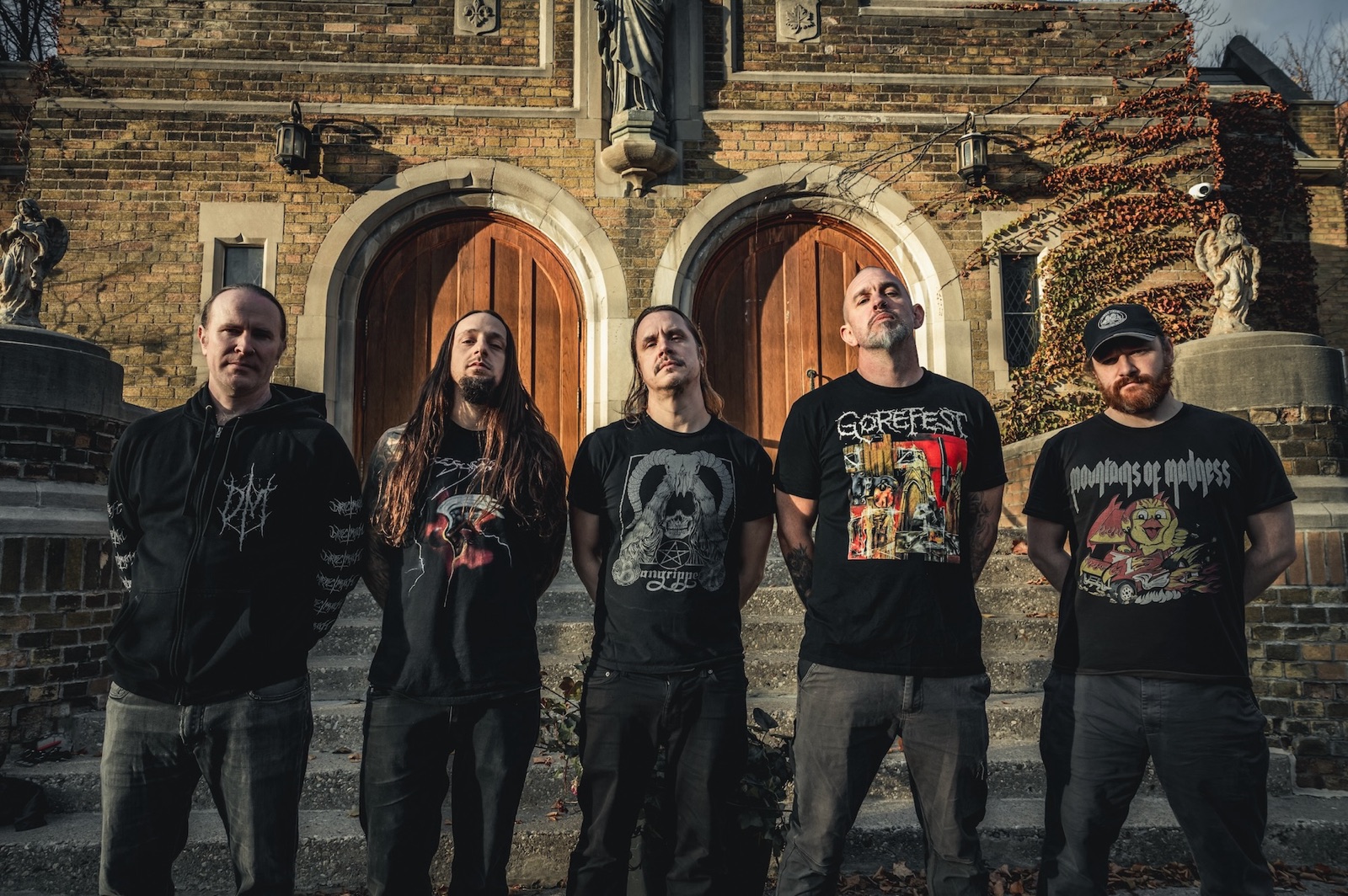
PSYCROPTIC. Photo by Rae Chatten.
Have you finalized the setlist yet?
Not yet. I live in Melbourne and the rest of the guys are in Tasmania, so I'm heading off next week for rehearsals. We've got an idea, but we don't know the running order yet, or which songs will make the cut. It'll take a few shows to feel out what actually works live — some new songs sound like they should work and then just don't. So there's a fair bit of trial and error. We're excited to play quite a few songs off this album, because I think a lot of it will translate well to a live set, but we'll see which ones actually stick.
Are there songs that turned out great on record, ones you genuinely like, but that just didn't work live — or were a real challenge?
Oh, all the time. One thing we won't do is record a song we can't play live, obviously — so technically we can play everything, it's just a matter of rehearsing it. But sometimes you pick a song thinking, "This is going to be killer," and it just doesn't land. Other times a song's fine, it's just in the wrong spot in the set. When we were touring behind Divine Council, we opened a lot of shows with a track called "Enslavement," and it went down terribly — until we moved it to the end of the set, and suddenly it was perfect, the ideal closer, definitely not an opener. So sometimes just shuffling the running order fixes it. Other times you stick with a song thinking it'll click eventually and it just doesn't, for whatever reason. There are a few I genuinely love playing that just don't go over as well as others, no matter what we do.
Do you prefer touring, or creating new music and putting out albums?
Probably creating — that's the part I really love. I like touring too, but it gets a little harder the older you get and the more responsibilities pile up; each tour is a bit more of a challenge than the last. The creative side is more rewarding, because you start with nothing and end up with a song out of thin air. I love both, and both can be equally frustrating at times, but creating wins out — just by a little.
You've mentioned before that most of the band is based in Tasmania, and that PSYCROPTIC's roots are there — you've even got the nickname "Tasmanian Devils," and you've taken part in a fundraiser for an organization researching how to stop the disease that's been killing a lot of the actual Tasmanian devils. Do you still feel that strong connection to the island, and that it runs deep in the band's identity?
Yeah, it's home. Even though I don't personally live there anymore, PSYCROPTIC is a Tasmanian band. Every time I go back it's, "This is home" — I just happen to live somewhere else now. It's a beautiful, genuinely unique place, and the people down there are awesome. It's definitely the band's home, even though we're spread out a bit these days. Todd Stern's based in New Jersey, but he's an honorary Tasmanian at this point, and we always love playing and rehearsing there. Joe and Jason are never leaving Tasmania, so yeah — that's PSYCROPTIC's home.
Do you have any other plans to work toward environmental causes the way you did in the past?
If the right one comes along, yeah. It's always a tricky one, because — and this is going to sound harsh, which isn't the intent — if you back one cause, another one asks, "What about us?" and then another, and suddenly you're picking and choosing, and people start bringing politics into it, and it gets messy. The Tasmanian devil one was the obvious one: it's our home, we had to help. Here and there we'll do a benefit show, or support something we actually have a real connection to, but you can't say yes to everything. If you do, it just opens the door to more causes you might not feel as strongly about. We've done benefit shows for personal friends, and that's always case by case — of course we'll do that. But if someone emails us about a cause we don't know anything about, the honest answer is I wish them the best of luck, but we've only got so many hours in the day. The Tasmanian devil one, though, was a no-brainer.
And to close — for people who might be hearing you for the first time, and this is album number nine —
Number nine, yeah.
— what do you want a first-time listener to take away from your music?
Honestly, I just hope they enjoy it. There's no real message — we're not pushing any agenda. If you like it, show a friend, tell someone, come to a show, buy a T-shirt. I'm not going to try and tell people what to think. But if it clicks for you, just listen to it, enjoy it, and play it for your mates.
PSYCROPTIC on the web: Website · Facebook · Instagram · YouTube
PSYCROPTIC on Metal Blade Records.
The Pulse of Annihilation is out now on Metal Blade Records.
Thanks to Liz Ciavarella-Brenner at Earsplit PR for arranging this interview.
Video version: